Ethernet (Medium Access Control Protocol)
Ethernet is a widely-used Medium Access Control Protocol that facilitates communication on a shared line. When a node sends a message, it includes a destination address and broadcasts it to all nodes on the network. Each machine checks if the message is meant for them and processes it accordingly. Collision handling is essential when multiple nodes transmit simultaneously. Nodes wait for their turn and introduce random delays to avoid repeated collisions. This article explores Ethernet protocol mechanisms, including message broadcasting, collision resolution, and network configurations in both LAN and WAN settings.

Ethernet (Medium Access Control Protocol)
E N D
Presentation Transcript
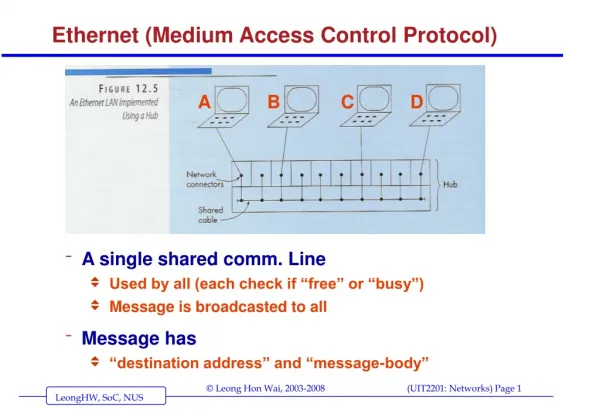
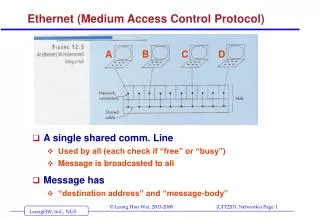
Ethernet (Medium Access Control Protocol) • A single shared comm. Line • Used by all (each check if “free” or “busy”) • Message is broadcasted to all • Message has • “destination address” and “message-body” A B C D
A B C D D message Not mine. Discard it… Ethernet Protocol (how it works) • Node A wants to send something to node D • Message’s “destination address” = D • Message is broadcasted to all… • Every Machine checks • If not mine, then discard; else process message; My message!! Process it…
Ethernet Protocol (Collision) • What if shared line is busy when node B wants to send? • Eg: If node A is currently sending…. • Node B waits… and send after node A is done. • What if many nodes are waiting… • And simultaneously send when node A is done! A B C D
Length of collision delay is randomly generated. So, different delays for different waiting nodes…. LAN How to Resolve Collisions !!
Paths from B to F? What if node C is faulty? WAN Network….