Understanding Statistical Multiplexing and TCP Congestion Control Mechanisms
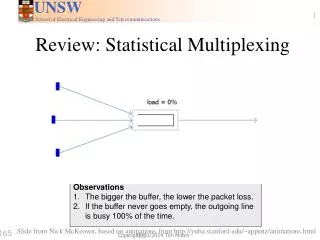
This review analyzes two key concepts in network traffic management: statistical multiplexing and TCP congestion control. It discusses how a larger buffer can lead to lower packet loss, as a consistently filled buffer ensures that the outgoing line is utilized effectively. Additionally, the TCP congestion control mechanism is explored, highlighting the rules for adjusting the window size based on acknowledgments and packet loss. The content is illustrated with animations from Stanford University, providing a visual representation of these principles.

Understanding Statistical Multiplexing and TCP Congestion Control Mechanisms
E N D
Presentation Transcript
Review: Statistical Multiplexing • Observations • The bigger the buffer, the lower the packet loss. • If the buffer never goes empty, the outgoing line is busy 100% of the time. Slide from Nick McKeown, based on animations from http://yuba.stanford.edu/~appenz/animations.html 975165 19/11/2014 Tim Moors
Review: TCP Congestion Control • Rule for adjusting W • If an ACK is received: W ← W+1/W • If a packet is lost: W ← W/2 Only Wpackets may be outstanding 9751XE Slide from Nick McKeown, based on animations from http://yuba.stanford.edu/~appenz/animations.html 19/11/2014 Tim Moors