Chapter 13 Acids and Bases
740 likes | 889 Vues
This chapter explores the Brønsted-Lowry acid-base model, which emphasizes proton transfer in acid-base reactions. It covers the ion product of water, defines pH and pOH, and analyzes weak acids and bases along with their equilibrium constants. The chapter also examines the characteristics of strong acids and bases, explaining how they ionize in water. Additionally, the importance of pH in biological systems and measuring methods, such as pH meters and indicators, is discussed. This comprehensive overview highlights key concepts for understanding acid-base chemistry.


Chapter 13 Acids and Bases
E N D
Presentation Transcript
Outline 1. Brønsted-Lowry acid-base model 2. The ion product of water 3. pH and pOH 4. Weak acids and their equilibrium constants 5. Weak bases and their equilibrium constants 6. Acid-base properties of salt solutions
Review from Chapter 4 • The Arrhenius definition of acid and base • Acids produce H+ in water • Bases produce OH- in water • H+ from acids combines with OH- from bases to produce water in a reaction called a neutralization
Brønsted-Lowry Acid-Base Model • Brønsted-Lowry • Johannes Brønsted (1879-1947) • Thomas Lowry (1874-1936) • Brønsted-Lowry model focuses on the reaction that takes place between acid and base, rather than on the independent nature of the acid or base, as the Arrhenius model does • Acids donate H+ to bases • Bases accept H+ from acids
The Nature of H+ • The H+ ion is the medium of exchange in a Brønsted-Lowry reaction • H+ can also be called a proton • Acid-base reactions involve proton exchange
Conjugate Pairs • The species that forms when a proton is removed from an acid is called the conjugate base of the acid • If the acid is HB, the conjugate base is B- • The only difference between the members of a conjugate acid-base pair is the position of the proton • A species that can either accept or donate a proton is called amphiprotic • Consider water: • OH- H2O H3O+ Remove H+ Add H+
The Hydronium Ion • Another way to write the H+ ion is as H3O+ • H3O+ is the hydronium ion • H+ exists in water as hydronium ion, since H+ itself would not be stable in water • Depending on the reason for writing the reaction, either H+ or H3O+ can be used, and interchangeably • The only difference is the inclusion or exclusion of the H2O molecule
The Ion Product of Water • Water can react with itself in a reaction called autoionization • Water can react with itself in an acid-base reaction: • H2O + H2O ⇌ H3O+ (aq) + OH- (aq) • An alternate way to write the reaction is: • H2O ⇌ H+ (aq) + OH- (aq)
Equilibrium and the Auto-Ionization of Water • H2O ⇌ H+ (aq) + OH- (aq) • Recall that concentrations can be used to write equilibrium constant expressions • K for this reaction is [H+][OH-] • This K is called theion product constant of water, Kw • Kw = [H+][OH-] • At 25 °C, Kw = 1.0 X 10⁻¹⁴
Concentrations of H+ and OH- in pure water • In pure water, [H+] = [OH-] = 1.0 X 10⁻¹⁴ • [H+] = 1.0 X 10⁻⁷ • [OH-] = 1.0 X 10⁻⁷ • When the two concentrations are equal, the solution is said to be neutral • If [H+] > 1.0 X 10⁻⁷, then [OH-] < 1.0 x 10⁻⁷ and the solution is acidic • If [OH-] > 1.0 X 10⁻⁷, then [H+] < 1.0 x 10⁻⁷ and the solution is basic
pH • Defining equation for pH • The higher the pH, the less acidic the solution • The lower the pH, the more acidic the solution
pOH • Defining equation for pH • The higher the pOH, the more basic the solution • The lower the pOH, the more acidic the solution
pH and Blood • From the previous example, it is seen that the [H+] in blood is very small, about 4.0 X 10⁻⁸ M • Small changes in [H+] can have dramatic physiological effects • Many biological reactions depend on [H+] • An increase in [H+] from 4.0 X 10⁻⁸ to 4.0 X 10⁻⁷ can increase the a reaction rate by a power of 10 • Small increases in [H+] can lead to acidosis; small decreases in [H+] can lead to alkalosis • Effective control of many physiological reactions depends on pH control
pH of Strong Acids • Recall from Chapter 4 that some acids are strong • HCl, HBr, HI, HClO4, HNO3, H2SO4 • These completely ionize in water • [H+] is equal to the [H+] of the acid • A 0.10 M solution of HCl has [H+] = 0.10, so the pH of the solution is 1.0
pH of Strong Bases • Recall as well that some bases are strong: • LiOH, NaOH, KOH, Ca(OH)2, Sr(OH)2, Ba(OH)2 • These bases ionize completely to OH- • pOH is dependent on the concentration of the strong base • For an 0.10 M solution of NaOH, • [Na+] = [OH-] = 0.10 • pOH = 1.0 • pH = 13.0
Measuring pH • pH can be measured with a pH meter • Translates [H+] into an electrical signal • Signal is shown on an analog or digital meter calibrated in pH units
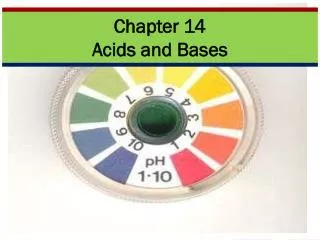
pH Indicators • Universal indicator • Mixture of substances that change color depending on the concentration of H+ • Less accurate than pH meter • Depending on the indicator used, can display pH over a narrow or wide range of [H+] • Some plants can act as pH indicators • Color of some flowers in plants is dependent on the pH of the soil in which the plant is grown
Weak Acid Equilibrium Constants • Weak acids ionize only partially • Prototype reaction • HB (aq) + H2O ⇌ H3O+ (aq) + B- (aq) • Two types of species that behave as weak acids 1. Molecules with an ionizable hydrogen atom • HNO2 (aq) + H2O ⇌ H3O+ (aq) + NO2- (aq) 2. Cations • NH4+ (aq) + H2O ⇌ H3O+ (aq) + NH3 (aq)
Metal Cations as Acids • Many metal cations act as weak acids in water solution as well • Zn(H2O)42+ (aq) + H2O ⇌ H3O+ (aq) Zn(H2O)3(OH)+ (aq) • The bond that forms between the oxygen and the metal ion weakens the O-H bond • H+ is more easily ionized as a result of the weakened bond
Equilibrium Constants for Weak Acids • HB (aq) + H2O H3O+ (aq) + B- (aq) • Ka is the acid equilibrium constant • Simplifying the above to HB (aq) H+ (aq) + B- (aq) • Ka values are related to the weak acid strength • The smaller Ka is, the weaker the acid is
pKa • pKa = -logKa • The smaller pKa is, the stronger the acid • pKa follows the trend for pH
Percent Ionization • The percent ionization of a weak acid is defined as • For the calculation in example 13.5, the percent ionization is about 12 % • Note that the percent ionization depends on the molarity of the weak acid
Calculating [H+] in a Water Solution of a Weak Acid • We can use the process for calculating equilibrium pressure for gaseous reactions that we looked at in Chapter 12 to calculate the equilibrium concentration of [H+] for a weak acid • The relationship between [HB], [H+] and [B-] is given in the equilibrium expression itself
Algebra Review – Quadratic Equations • Recall that for a quadratic equation in the form • The roots are
Approximations Used in Calculations • The value of Ka is usually known no more accurately than about ±5% • When solving for the unknowns used to work the equilibrium problem, for the expression • Where a is the initial concentration of weak acid, you can neglect x in the denominator if doing so does not introduce an error of more than 5%, i.e.,
Approximations and Percent Ionization • When • Multiplying by 100% will give the percent ionization: • If the percent ionization is 5% or less, you may make the approximation. • If the percent ionization is greater than 5%, the quadratic formula or the successive approximation method is required
Polyprotic Weak Acids • Acids containing more than one ionizable hydrogen are called polyprotic • The anion formed in one step produces another H+ in a successive ionization step • The equilibrium constant becomes smaller with each successive step