Download
1 / 23
230 likes | 343 Vues
Viruses are nonliving entities that require host cells to replicate. This overview covers famous viruses such as Influenza, HIV, and SARS, and discusses their basic components: nucleic acid, capsid, and, in some cases, a viral envelope. We explore host range, highlighting that viral infections are specific to certain hosts and cell types. The viral reproductive cycle is detailed, encompassing attachment, entry, biosynthesis, assembly, and release. Additionally, we differentiate between lytic and lysogenic cycles, particularly in bacteriophages, emphasizing their importance in viral biology.

E N D
Viruses AP Biology Unit 2 Images taken without permission from http://www.zo.utexas.edu/faculty/sjasper/images/ebola_virus.jpg and http://www.bioitworld.hu/adat/200316/21662/sars_virus.jpg
“Famous” Viruses • Influenza (the Flu virus) • Actually many different strains (including H1N1) • Cold Virus (Rhinovirus) • Actually many different strains • HIV • SARS (Coronavirus) • Chicken Pox (Varicella Zoster)
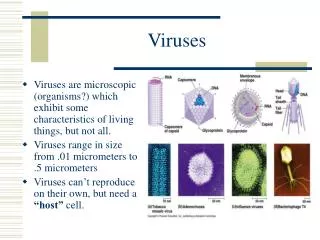
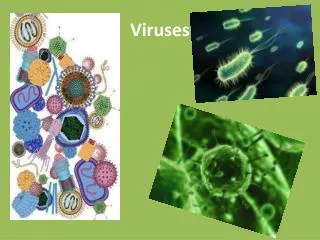
Viruses are nonliving • Viruses are considered nonliving because • They do not have cellular structure • They require another living cell to replicate (copy) themselves –infectious particles • Viruses are very small in size compared to even a bacterium
Capsid Nucleic Acid Viral Envelope Basic Components of a Virus • 3 basic components: • Nucleic Acid (DNA or RNA) • Capsid (Protein Coat surrounding nucleic acid) • Viral Envelope (derived from host cell membranes) – NOT PRESENT IN ALL VIRUSES
Question… • Why might having a viral envelope help a virus? (hint: what does it resemble/ what was it derived from?) • Helps it bind to the host cell • May also help protect it (camouflage it)
Host Range • Viral infection is limited to specific hosts and specific cells within that host • For example: • Rabies – only infects warm-blooded animals • Measles only infects humans • Flu viruses infect the tissues in the upper respiratory tract • HIV only infects specific immune system cells
Viral Reproductive Cycle • Attachment: Virus binds to host cell • Entry: Virus enters host cell • Biosynthesis: Viral genome and proteins are synthesizes • Assembly: New viruses self-assemble • Release: New viruses exit cell (may kill cell in the process)
A Closer Look at Biosynthesis Image obtained without permission from http://bcs.whfreeman.com/thelifewire/default.asp?s=&n=&i=&v=&o=&ns=0&uid=0&rau=0
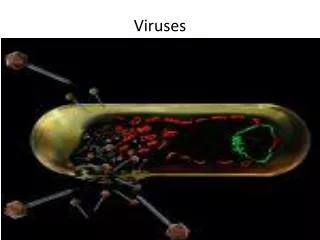
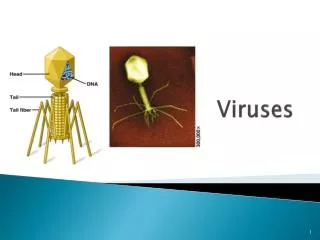
Nucleic Acid Capsid Bacteriophages • Viruses that infect bacteria • Inject their DNA into host cell • Also called phages
Lytic Cycle • Results in the death of the infected bacteria • Phage that only carry out the lytic cycle are known as virulent phage
Phage DNA is injected in Steps of the Lytic Cycle
Question… • Do you remember how bacteria protect themselves from bacteriophages (foreign DNA)? • They have restriction enzymes to cut them up!
Temperate Phage • Temperate Phage are bacteriophage that can go through the lytic cycle OR the lysogenic cycle • In the lysogenic cycle, the phage does not cause the bacterial host to burst & die
Lysogenic Cycle The lysogenic cycle only consists of this half of the diagram The phage is “dormant” – gets copied with the rest of the DNA
Animal (Human) Viral Infection • Many animal (human) viruses have a viral envelope • There are glycoproteins attached to the viral envelope that help the virus bind to the host cell
Step 2: Through endocytosis Step 1: Glycoproteins on viral envelope bind to receptors on host cell Step 3: Biosynthesis of viral components Step 4: Assembly of Viruses Step 5: New viruses bud out of host cell, gaining a viral envelope
Important Concept • Even though the drawing only shows one new virus coming out, in actuality many (tens of thousands) viruses will come out!
RNA Viruses • Some viruses have RNA as their nucleic acid • Also known as retroviruses • Also have to have reverse transcriptase included in virus • Creates a DNA template from the RNA • Ex. HIV
What about H1N1? • H1N1 is a new strain of the influenza virus • First detected in April 2009 • Why was it called “swine flu”? • originally found that some of the genes in virus were similar to genes in the flu virus in pigs (swine) later found to be very different • Contains genes from flu viruses found in pigs in Asia, Europe, birds and humans • “quadruple assortment”
What about H1N1? • Why are we so worried about this flu? • Because it’s a new strain that hasn’t been seen before • Most people’s immune systems don’t have immunity against this virus • This will cause more infections than the seasonal flu. • Spreading quickly among young people.
Animations of Lytic & Lysogenic Cycles • Animation