Download
1 / 18
180 likes | 308 Vues
In an evolving cyber landscape, Ravi Sandhu outlines the fundamental shift in role-based access control (RBAC) principles. Highlighting the inadequacies of existing security frameworks, Sandhu proposes an innovative perspective that integrates abstraction of privileges, least privilege policies, and the separation of administrative functions. RBAC is positioned as adaptable and policy-neutral, allowing it to evolve alongside emerging technologies and threats. This lecture prompts a re-examination of access control methods to ensure better security and agility in an increasingly complex cyber environment.

E N D
ASCAA Principles for Next-Generation Role-Based Access Control Ravi Sandhu Executive Director and Endowed Chair Institute for Cyber Security Univ of Texas at San Antonio ravi.sandhu@utsa.edu www.profsandhu.com
The State of Cyber Security • We are in the midst of big change in cyber space • Nobody knows where we are headed • So far we have done a pretty bad job in cyber security • There is hope • New services will not be held back • Need for security will remain • “Good enough” security is achievable
Security Schools of Thought • OLD THINK: We had it figured out. If the industry had only listened to us our computers and networks today would be secure. • REALITY: Today’s and tomorrow’s cyber systems and their security needs are fundamentally different from the timesharing era of the early 1970’s.
Change Drivers Stand-alone computers Internet Vandals Criminals Mutually suspicious yet mutually dependent security Enterprise security Many and new innovative services Few standard services
DAC: Discretionary Access Control but only to the original • The owner decides who gets access • Anyone with read access can copy and owns the copy • The classic formulation of DAC is fundamentally broken • Solving the owner-control problem correctly is high priority (but a different lecture) First emerged: early 1970s First models: early 1970s
MAC: Mandatory Access Control • Who gets access is determined by security labels • A user’s security label is assigned by a security officer • Copies are automatically labeled correctly by the security system First emerged: early 1970s First models: early 1970s
MAC: Mandatory Access Control TS S Lattice of security labels C Information Flow U
Orange Book 1983 • There is MAC (good) • There is DAC (weak) • Don’t need anything else
RBAC: Role-Based Access Control • Access is determined by roles • A user’s roles are assigned by security administrators • A role’s permissions are assigned by security administrators • Control on copies determined by configuration of roles First emerged: mid 1970s First models: mid 1990s Is RBAC MAC or DAC or neither?
Fundamental Theorem of RBAC • RBAC can be configured to do MAC • RBAC can be configured to do DAC • RBAC is policy neutral RBAC is neither MAC nor DAC!
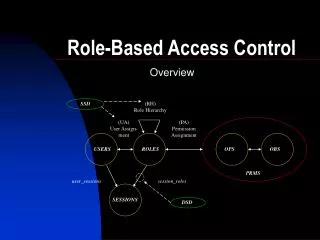
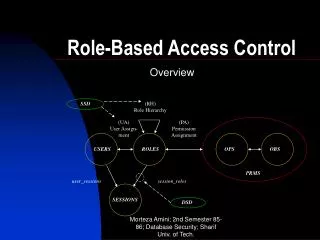
... RBAC96 Model ROLE HIERARCHIES USER-ROLE ASSIGNMENT PERMISSIONS-ROLE ASSIGNMENT ROLES PERMISSIONS USERS SESSIONS CONSTRAINTS
Example Role Hierarchy Director (DIR) Project Lead 1 (PL1) Project Lead 2 (PL2) Production 1 (P1) Quality 1 (Q1) Production 2 (P2) Quality 2 (Q2) Engineer 1 (E1) Engineer 2 (E2) Engineering Department (ED) Inheritance hierarchy Employee (E)
Example Role Hierarchy Director (DIR) Project Lead 1 (PL1) Project Lead 2 (PL2) Production 1 (P1) Quality 1 (Q1) Production 2 (P2) Quality 2 (Q2) Engineer 1 (E1) Engineer 2 (E2) Engineering Department (ED) Inheritance and activation hierarchy Employee (E)
... Permission-role review is advanced requirement Inheritance and/or activation NIST/ANSI RBAC Standard Model 2004 ROLE HIERARCHIES USER-ROLE ASSIGNMENT PERMISSIONS-ROLE ASSIGNMENT ROLES PERMISSIONS USERS Limited to separation of duties Overall formal model is more complete SESSIONS CONSTRAINTS
Founding Principles of RBAC96 • Abstraction of Privileges • Credit is different from Debit even though both require read and write • Separation of Administrative Functions • Separation of user-role assignment from role-permission assignment • Least Privilege • Right-size the roles • Don’t activate all roles all the time • Separation of Duty • Static separation: purchasing manager versus accounts payable manager • Dynamic separation: cash-register clerk versus cash-register manager
ASCAA Principles for Future RBAC • Abstraction of Privileges • Credit vs debit • Personalized permissions • Separation of Administrative Functions • Containment • Least Privilege • Separation of Duties • Usage Limits • Automation • Revocation • Assignment: (i) Self-assignment, (ii) Attribute-based • Context and environment adjustment • Accountability • Re-authentication/Escalated authentication • Click-through obligations • Notification and alerts
Usage Control: The UCON Model • unified model integrating • authorization • obligation • conditions • and incorporating • continuity of decisions • mutability of attributes
Conclusion • RBAC is here to stay • ABAC will still use roles as one attribute • Attribute-based assignment to roles • Access control needs agility • Usage limits • Automation (self-administration) • Accountability • This is already happening • Our models have fallen behind • ASCAA principles apply beyond RBAC • UCON model incorporates ASCAA