Develop a critical eye…
To excel in selecting books about American Indians, one must develop in-depth cultural knowledge of specific nations. Explore dedicated websites and works of both fiction and nonfiction authors from that nation to internalize essential information. This expertise not only enriches understanding but also enables readers to identify misrepresentations in literature. Recognizing historical contexts, such as the impact of boarding schools or cultural practices like the Pueblo sharing traditions, equips educators and librarians to make informed selections, avoiding stereotypes and inaccuracies in representation.

Develop a critical eye…
E N D
Presentation Transcript
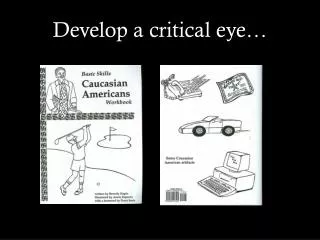
Strategy to become adept at selection of books by/about American Indians: Know one nation in-depth. Read its website, writers of fiction and nonfiction who are of that nation.Internalize that information! Your expertise will help you develop a critical eye that can spot problems in materials of other nations.
Example: Expertise in Pueblo traditions of “throw” (sharing of harvest) would help you spot problems in this book:
Example: Knowing about devastation wrought by boarding schools would help you recognize its misrepresentation School Library Journal: “An excellent addition to a popular series.” Booklist: “A solid addition to the Dear America series.” Kirkus: “A strong addition to Rinaldi’s ongoing historical explorations.” Scholastic, 1991
Example: Knowing facts about Indian Removal and Native culture would help you recognize problems in classics 1804: Indian Territory created 1845: almost 100,000 Choctaw, Cherokee, Chickasaw, Creek, Seminoles in Indian Territory 1866: Laura Ingalls born 1868: Charles Ingalls moves family to Indian Territory.
After watching video, study these pages: p. 1 p. 6 p. 55 - 56 p. 122 p. 134 – 139 p. 211 p. 229 p. 290-291
Nonfiction (bio) Three hundred years ago, there was no United States of America. Instead, there were thirteen English colonies in North America. Three hundred years ago, there was no United States of America. Instead, there were hundreds of Native Nations. Europeans who had fled Europe had come to North America and were occupying lands that belonged to the Native Nations. These Europeans set up thirteen English colonies. Harcourt, 2008
Collection Development guides by Disher (2007) and Larson (2008) state books can be weeded on these criteria: • Misleading • Inaccurate • Racial Bias • Stereotyping • Balance