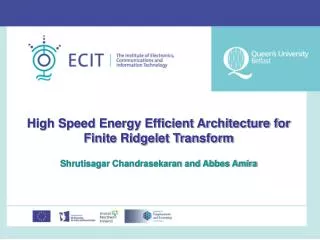
Innovative High Frequency Electronics Research in Space Technology
The High Frequency Electronics Research Cluster at ECIT, led by Professor Vincent Fusco, focuses on advancing microwave to sub-millimetre wave technology for electronic systems. As the largest HFE group in the UK, it comprises world-class researchers and sophisticated facilities, including anechoic chambers and on-wafer probing. Our mission includes developing novel MEMS technologies, innovative filtering systems, and antennas for space applications. Notable achievements include groundbreaking technology for Earth observation missions and the deployment of prototype dichroics for satellite instruments.

Innovative High Frequency Electronics Research in Space Technology
E N D
Presentation Transcript
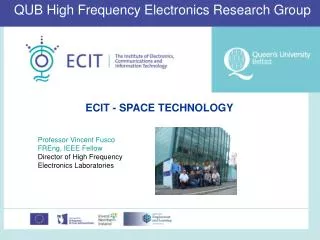
QUB High Frequency Electronics Research Group ECIT - SPACE TECHNOLOGY Professor Vincent Fusco FREng, IEEE Fellow Director of High Frequency Electronics Laboratories Overview September 2004
The High Frequency Electronics Research Cluster - Mission Statement: To develop state of the art microwave through sub-millimetre wave technology and techniques for application in electronic systems Largest HFE group in the UK - Personnel Academics 6 ft, 1 pt world class researcher, 1 visiting professor 10 Post Doc, including 3 Marie Curie Fellows, 1 RAEng/EPSRC Fellow 2 Senior Engineers 17 PhDs 1 Technician 5 visiting graduate researchers
Main Facilities • Software • ADS • HFSS • CST • OEM FSS and nonlinear analysis • NEC • Primary Hardware • 10m Far Field Antenna Anechoic Chamber • 2mx2m NSI near Field Chamber • Reverberation Chamber • On-Wafer CW Probing to 110 GHz • Free Space quasi-optical measurement to 850GHz • Wire Bonding and hybrid fabrication
Transceiver/ Antenna Technology Microwave MM/SUB MM-Wave Systems Novel MEMS FSS and Artificial EM Media Advanced linear /non-linear EM simulation
Timeline 2001: The High Frequency Electronics Research Cluster supported by Astrium UK and EPSRC initiate research on a new dichroic technology based on precision Silicon micromachining 2006: RAL Space deploys prototype dichroics on MARSCHALS instrument and successfully demonstrates detection of ozone in flight trials 2007: The European Space Agency (ESA), the UK Space Agency and CEOI provides R&D funds to develop the technology for future Earth Observation missions 2010: ESA awards major contract to prototype the critical dichroic filter for the Meteorological Polar Satellite System (METOP) mission 2012: ESA awards QUB preferred bidder status for the supply of prototype dichroics for MWS METOP flight instruments 2017: Flight models to be delivered 2020/22/25: METOP launches Tight integration with UK Space catapult centre and CEOI
Recent World Space Firsts Include: • 2012 Worlds first mobile Sat Comm • terminal based on self steering • technology • 2010 World lowest insertion • loss sub-mm wave FSS • 2008 Theory and experimental mapping of distributed PIM
Advanced PIMs and multipactor Characterisation and Analysis Fibre bundles PTFE ~ 50µm Cu trace Y X Z Biasing connection Material EM Characterisation Liquid Crystal Characterisation
Millimetre Wave MMIC Technology SiGe/GaAS MMIC DEVICES FORCommunications/Telemetry/Radar/Imaging
Metamaterials and metasurfaces for conformal, tunable, and frequency and polarisation sensitive devices Interwoven spiral arrays l/p~40 Tunable NLC FSS/Polarisers Broadband polarisers (C-band to submm-waves) Voltage controlled surface Flat optics Ultra-thin Artificial Magnetic Surface Radar Absorber
Filter technology Multipaction-free VHF/UHF helical resonator filters Surface integrated waveguide technology E-plane and ridge waveguide low/band-pass filters
Facility Tour • Demonstrations - Retrodirective Self Steering Antenna - Reconfigurable Liquid Crystal Based Antenna - Frequency Selective and Anisotropic Surfaces (FSS)