Understanding Figurative Language and Literary Devices in Literature
This guide explores the fundamentals of figurative speech and literary devices, essential tools for enhancing writing. It covers key concepts such as personification, hyperbole, metaphors, and alliteration, along with their functions in storytelling. The resource also includes an overview of root words like "audi" (to hear) and "vis" (to see) and examines different genres of literature, such as mystery, historical fiction, and science fiction. Ultimately, it sheds light on how these elements create vivid imagery and convey deeper meanings in narratives.

Understanding Figurative Language and Literary Devices in Literature
E N D
Presentation Transcript
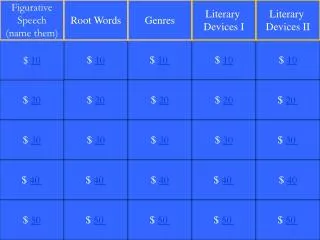
Figurative Speech (name them) Root Words Genres Literary Devices I Literary Devices II $ 10 $10 $10 $10 $10 $ 20 $20 $20 $20 $20 $30 $30 $30 $30 $30 $40 $40 $40 $40 $40 $50 $50 $50 $50 $50
The giant’s steps were thunder as he ran toward Jack.
They use figurative speech to create a picture in the reader’s mind.
What root words means “see, look”? DAILY DOUBLE
This genre takes place in history and is not true but behave in ways they would in that period of time.
This genre has a setting that takes place in modern times and the story could happen but did not. DAILY DOUBLE
This genre is a true story about someone’s life but written by another person.
In this genre, the setting is usually set in the distant future and is based on scientific facts.
A ____________ is a person or other figure that is part of a story.
_________ is the time and location (place) in which story events occur.
_________ is the major idea or lesson that a story conveys (communicates) about life. DAILY DOUBLE
_________ is the series of related events that make up the story.
_____________ occurs when the author tells about an event that happened before the time of the story.
___________ means suggesting beforehand what is going to happen later in the story.
Which point of view is this? I groped my way down the tree and fell with a thud into the mud. Then I heard the guard dogs barking furiously as they bounded toward me. My heart began to pound.
Which point of view is this? She saw that her father was laughing hysterically, but she had no idea why. Was he reading that silly book again?
Which point of view is this? In the school cafeteria, Jon felt lonely and out of place, so he gobbled his lunch as fast as he could. On the other side of the table, Jeanne was wondering if she would ever get used to this noisy, crowded school. As for Liddy, she was as depressed as ever.
1. ___________ is the attitude or style of expression used to write. 2. ___________ is the general feeling in a story. It refers to the emotion a writer makes a reader feel.