Exploring Computational Linguistics in Computer Science
90 likes | 220 Vues
Join Dr. Carl Alphonce in CSE 111 as we delve into the fascinating world of Computational Linguistics. This week, we will focus on Artificial Intelligence and its application in processing natural human language. We'll cover techniques for spoken and written language, including spelling and grammar checkers, natural language interfaces, and more. We will explore general problem areas like information retrieval, speech recognition, and natural language understanding. Get ready for an insightful discussion that bridges computer science with the intricacies of human communication.


Exploring Computational Linguistics in Computer Science
E N D
Presentation Transcript
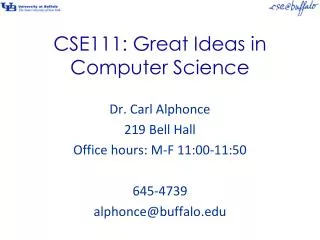
CSE111: Great Ideas in Computer Science Dr. Carl Alphonce 219 Bell Hall Office hours: M-F 11:00-11:50 645-4739 alphonce@buffalo.edu
cell phones off (please)
Announcements • HW5 • Part 1 – work on this week • Part 2 – work on next week • due April 16 • 4/5-4/9: Artificial Intelligence • 4/12-4/16: Theory • 4/19-4/23: Exam week
Today’s Agenda • Artificial Intelligence • Computational linguistics • Knowledge representation and reasoning • Game playing
What is Computational Linguistics? • The study of techniques for processing natural human language by computer. • “computational techniques that process spoken and written language, as language” [Jurafsky & Martin,Speech and Language Processing, pg. 2]
Some applications – extant and envisioned • spelling checkers • grammar checkers • natural language interfaces • information extraction • text summarization • conversational agents • machine translation
General problem areas • information retrieval (finding sources) • information extraction (extracting from sources) • speech recognition • natural language understanding • inference (drawing conclusions) • natural language generation • speech synthesis
Levels of processing • phonetics/phonology – sounds • morphology – word structure • syntax – sentence structure • semantics – meaning • pragmatics – goals of language use • discourse – utterances in context