Occupational COPD
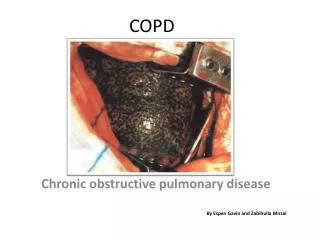
Occupational COPD. M. Amini (MD) Aminim@mums.ac.ir. Patient history. A 45 y/o man non-smoker with history of 15 years working at rubber industry Presented with dyspnea, cough and phlegm in recent few years Physical examination reveals nothing specific. Chest radiography showed here.

Occupational COPD
E N D
Presentation Transcript
Occupational COPD M. Amini (MD) Aminim@mums.ac.ir
Patient history • A 45 y/o man non-smoker • with history of 15 years working at rubber industry • Presented with dyspnea, cough and phlegm in recent few years • Physical examination reveals nothing specific
Spirometery showed these values: • FEV1= 44% with BD 3% • FVC= 65% with BD 5% • FEV1%= 50%
What is the diagnosis? • Does it relate to my work history? • What about prognosis? • Is it treatable? • How much does it cost?
Chronic obstructive pulmonary disease (COPD) is a disease state • characterized by airflow limitation • that is not fully reversible
Chronic bronchitis, or the presence of cough and sputum production for at least 3 months • in each of two consecutive years, remains a clinically and epidemiologically useful term.
Emphysema, or destruction of the gas-exchanging surface of the lung (alveoli) • is a pathological term that is often (but incorrectly) used clinically
cough and sputum may precede the development of airflow limitation • conversely, some patients develop airflow limitation without chronic cough and sputum production.
Occupational COPD develops slowly • the airflow limitation is chronic • does not reverse when exposure is discontinued
So, diagnosis by methods similar to occupational asthma, is not feasible
Epidemiologically, the identification of occupational COPD is based on • observing excess occurrence of COPD among exposed workers
COPD is currently the fourth leading cause of death in the world • and further increases in its prevalence and mortality can be predicted in the coming decades
Cigarette smoking is undoubtedly the main cause of COPD in the population • average decline in FEV1 in smokers is faster (60 ml/yr) than in non-smokers (30 ml/yr)
As only 15 to 20% of smokers develop clinically significant COPD • 6% of persons with COPD in the United States are never smokers
A sizeable proportion of the cases of COPD in a society (average 15%) • may be attributable to workplace exposures • dusts, noxious gases/vapours, and fumes (DGVFs)
The industries with increased risk include • Rubber • Plastics • and leather manufacturing • building services • textile manufacturing • and construction.
The fraction of cases in a population that arise because of certain exposures • is called population attributable risk (PAR)
The American Thoracic Society (ATS) calculated that PAR for COPD was about 15%
Smoking and occupational exposures had greater than additive effects
A cohort of more than 317000 Swedish male • construction workers was followed from 1971 to 1999
There was a statistically significant increase mortality • from COPD among those with any airborne exposure (relative risk 1.12)
Thus, physicians must be aware of the potential occupational etiologies for • obstructive airway disease and should consider them in every patient with COPD • An occupational history should be the first step in the initial evaluation of the patient
The length of time exposed to the agent • the use of personal protective equipment such as respirators, • and a description of the ventilation and • overall hygiene of the workplace • quantify exposure from the patient's history
Visit to the workplace by experts in occupational hygiene • material safety data sheets for workplace chemicals • manufacturers of the workplace substance
COPD Stage Spirometry (Postbronchodilator) • Mild • FEV1 ≥80% predicted, FEV1/FVC <0.7 • Moderate • 50% ≤ FEV1 <80% predicted, FEV1/FVC <0.7 • Severe • 30% ≤ FEV1 <50% predicted, FEV1/FVC <0.7 • Very severe • FEV1 <30% predicted, FEV1/FVC <0.7
Directions about the management and prevention of work-related diseases • can be applied to COPD as well
understanding the patient's occupational exposure • Removal of the respiratory irritants • substitution of non-toxic agents • are the best approach because they eliminate the work-related COPD hazard.
If substitution is not possible • ongoing maintenance of engineering controls • and improving work area ventilation
Administrative controls (e.g., transfer to another job or change in work practices) • and personal protective equipment (e.g., masks or respirators)
workers with COPD • may continue to work in their usual jobs if
their exposure to the inciting agent is diminished via • proper engineering controls • or respiratory protective equipment
The total annual cost to theNational Health Service for the treatment of COPD is • thoughtto be £491,652,000 in direct costs