Download

1 / 26
260 likes | 380 Vues
This lecture series by Dmitry Pogosyan at the University of Alberta explores the Cosmic Microwave Background (CMB) and its significance in cosmology. Theoretical foundations introduce how the CMB informs our understanding of the universe. Key findings from pre-WMAP and WMAP observations are discussed, focusing on anisotropy mapping, angular power spectrum, acoustic oscillations, and the implications for cosmological models. The lectures also address noise, cosmic variance, and advancements in CMB polarization measurements, providing a comprehensive overview of this crucial aspect of modern astrophysics.

E N D
CMB observations and results Dmitry Pogosyan University of Alberta • Lecture 1: What can Cosmic Microwave Background tell us about the Universe ? A theoretical introduction. • Lecture 2: Recent successes in the mapping of CMB anisotropy: what pre-WMAP and WMAP data reveals. Lake Louise, February, 2003
Phenomenology of the Angular Power Spectrum Curvature Acoustic Oscillations Drag Reionization Sachs-Wolfe Effect Damping Doppler Tensors large <-- scales --> small
Error origins – noise and ‘cosmic variance’ Cosmic Variance ~ Cl / √fsky Noise
Relikt, 1983 (USSR) • First CMB anisotropy data actively used to restrict cosmological models • Quadrupole dT/T < 4 x 10⁻⁵ • Many models where dismissed for failing this limit – hot (massive neutrino) dark matter, late decaying neutrinos ….
COBE-DMR, 1992 First detection of anisotropy large angular scale l < 20 growing initial slope ns=1.20.2 Low quadrupole power
Search for the first acoustic peak: • TOCO 1998 • Boomerang NAmerica, 1997
Mapping acoustic oscillations: • Boomerang 2000-2002 • Maxima 2000-2001 • DASI 2001
2002 CBI – damping tail Archeops – low l link to COBE ACBAR - medium-high l DASI – detection of polarization
Deficiencies • Covering only part of the sky leads to high cosmic variance uncertainties. (Noise is not an issue at l < 1000) • Patched coverage of the angular scales enhances role of systematics (e.g., calibration and beam uncertainties) which dominates analysis. • As the result – limited success of breaking some degeneracies • c – 8 as predictedfrom CMB • c – ns • c – gravitational waves
Wilkinson Microwave Probe (WMAP) – launch June 2001, first year data release – Feb 11, 2003 • 75-85% of full sky • 5 frequency channels at 23-94 Ghz • First 1year data – sky is covered twice • Each pixel observed ~3000 times. Cosmic variance limited up to l~600 • 0.5% calibration uncertainty
WMAPext k= -0.02 0.02 b = 0.0224 0.0009 cdm=0.135 0.009 h =0.71 0.04 ns = runs 1.2-0.93 c = 0.17 0.04 WMAP alone k= -0.03 0.05 b = 0.024 0.001 cdm=0.14 0.02 h =0.72 0.05 ns = 0.99 0.04 c= 0.15 0.07 Joint pre-WMAP k= -0.05 0.05 b = 0.022 0.002 cdm = 0.12 0.02 ns = 0.95 0.04 c<0.3-0.4
WMAP new advances – TE: c, adiabaticity • Measurement of TE polarization • Prove of adiabatic perturbation origin (TE anticorrelation at ~ 100) • c determination from TE enhancement at l < 20.
CMB Polarization • Full description of radiation is by polarization matrix, not just intensity – Stockes parameters, I,Q,U,V • Why would black-body radiation be polarized ? Well, it is not in equilibrium, it is frozen with Plankian spectrum, after last Thompson scattering, which is a polarizing process. • But only, because there is local quadrupole anisotropy of the photon flux scattered of electron. Thus, P and dT/T are intimately related, second sources first (there is back-reaction as well). • There is no circular polarization generated, just linear – Q,U. Level of polarization ~10% for scalar perturbations, factor of 10 less for tensors. Thus needed measurements are at dT/T~10-6 – 10-8 level. • As field on the sky – B, E modes (think vectors, but in application to second rank tensor), distinguished by parity.
WMAP new advances – extending the parameter list • Do we need ever precise determination of the parameters? Yes, if we want to explore larger parameter space., • WMAP: • Running ns – positive slope at low l, negative at higher l Recall COBE-DMR, it also preferred n~1.2 ! Also, low quadrupole – hint to new physics ? • Gravitational wave (tensor) contribution to dT/T is small < 0.72 of scalar component
“The Seven Pillars” of the CMB(of inflationary adiabatic fluctuations) • Large Scale Anisotropies • Acoustic Peaks/Dips • Gaussianity • Polarization, TE correlation • Damping Tail • Secondary Anisotropies • Gravity Waves, B-type polarization pattern Minimal Inflationary parameter set Quintessesnce Tensor fluc. Broken Scale Invariance
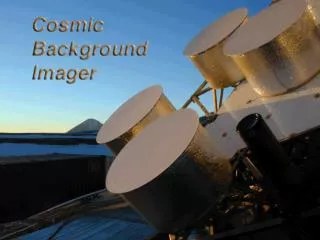
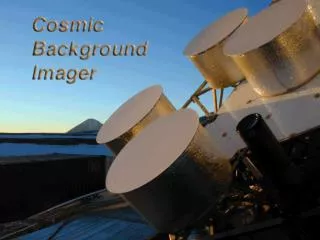
Cosmic Background Imager (CBI) BOOMERANG ACBAR