RECOVERY TECHNIQUES
This resource outlines five effective recovery techniques to help regain orientation and safely navigate when traveling on foot, especially in urban environments. Presented by faculty from Stephen F. Austin State University, these methods utilize systematic approaches such as checking surroundings with a recovery cane, assessing available sidewalks, and planning new routes when necessary. These techniques aim to enhance mobility, minimize veering off paths, and ensure safe travel near streets. Ideal for Orientation and Mobility specialists and individuals seeking to improve travel skills.

RECOVERY TECHNIQUES
E N D
Presentation Transcript
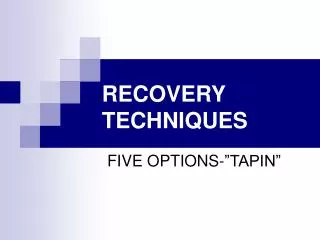
RECOVERY TECHNIQUES FIVE OPTIONS-”TAPIN”
PRESENTED BY THE STEPHEN F. AUSTIN STATE UNIVERSITY O&M FACULTY • Bill Bryan, COMS • Bob Bryant, COMS • Barry Stafford, COMS • Assistants: Laura Watson, Undergraduate O&M Student • Brenda Lee, Graduate O&M Student
RECOVERY-CANE CHECKING PROCEDURE • Move toes to grass. • Check straight in front • Check 45º away from parallel street • Clear toward parallel street until cane is pointed toward the street
OPTION ONE-(toward street) • If there is a sidewalk, turn 90 degrees facing the parallel street • Shoreline on the side of the desired direction of travel • If a sidewalk is located take it and clear both sides • If the street is located, turn 180º and shoreline away from the street. • If there is not a sidewalk toward the parallel street try option two.
OPTION TWO (away from street) • If grass or street is located on the street side, check 180º away from the parallel street. • If there is a sidewalk, turn 90 degrees and shoreline on side of desired travel. If there is no sidewalk away, try option three
OPTION THREE (Plow through) • If there is grass locate at 90 degrees on both sides, try to continue straight ahead. • Clear 180º every three to four steps to check for sidewalk • If surface becomes unsafe to travel on try option four.
OPTION FOUR(residential curb travel) • ONLY USE IF: • ON LEGAL SIDE (LEFT) OF STREET • STREET IS SAFE TO TRAVEL ON • Travel to street, walk along the edge and use touch trail technique until sidewalk or corner is located. • If cannot use safely, go to option five.
OPTION FIVE • Plan a new route
ADVANTAGES THESE OPTIONS WILL CORRECT: • Veering into and out of driveways • Off-set sidewalks toward and away from the street • Sidewalks covered with sand, grass, leaves, etc. • Dead end sidewalks
STREET RECOVERY • Option one of sidewalk recovery will also work when veering to the left or right of the sidewalk after a street crossing. • The three point will be utilized instead of shorelining.
RECOVERY FROM THE PARALLEL STREET • Stop and turn at least 90 degrees away from the parallel street. • Travel to the curb and clear 180 degrees checking for a sidewalk. • If sidewalk is not located, turn 90 degrees in the same directions as you turned to get out of the street and 3 point until a sidewalk is located.
VERIFYING PROPER DIRECTION OF TRAVEL • Place parallel traffic on the correct side • If there is no traffic or it is on the wrong side, shoreline on the side the parallel street should be on • Take the first sidewalk, it will either take you to the parallel street or you will be on the correct sidewalk