Affective Disorders
This exploration dives into the intricate relationship between affective disorders, emotional states, and the limbic system. Highlighting key disorders such as anxiety, depression, schizophrenia, and bipolar disorder, it analyzes the underlying neurobiology, including the roles of dopamine, serotonin, and norepinephrine. The recommendations include "Evil Genes" by Barbara Oakley as essential summer reading for further insight into these disorders. The text provides a comprehensive overview of how conditions like PTSD, OCD, and psychosis emerge from dysfunctions in brain structures like the amygdala and hippocampus.

Affective Disorders
E N D
Presentation Transcript
Emotional States and The Limbic System …recommended (summer) reading: Evil Genes by Barbara Oakley
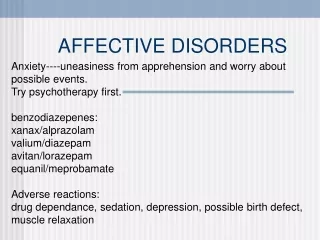
Classes of Affective Disorders and Diverse Brain Dysfunction • Anxiety • phobias, post-traumatic stress disorder, obsessive compulsive disorder • Neuropathology: limbic system • Psychosis • schizophrenia, multiple personality disorder • Neurobiology:dopaminergic system • Depression • post-partum, manic-depressive • Neurobiology: serotoninergic and noadrenergic systems
Anxiety • hyper-alert, resistant to change, context-dependent Hippocampus Amygdala HPA Cortisol
Depression • hypo-alert, ahedonia
Manic-Depressive (Bipolar) • waxes and wanes across months/years, stress is normally a trigger Robert Schumann’s productivity
Really? A chemical salt to treat bipolar disorder? • Lithium • can replace Na++ as a generator of action potentials • centrally decreases norephinephrine release and enhances serotonin synthesis • efficacious in humans and in mice (see work of CA McClung [PubMed])
Schizophrenia • severely out-of-touch with reality, delusions of grandeur, auditory and visual hallucinations, and highly hereditable
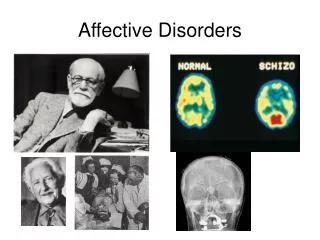
Neurobiology of Schizophrenia Hyperactivity in several brain areas Enlarged lateral ventricles Increased Dopaminergic Tonus (Euphoria)