Download
1 / 29
290 likes | 390 Vues
Explore how Integral Quadratic Constraint (IQC) theory ensures robust stability in Model Predictive Control (MPC) systems, analyzing examples, computation methods, and Zames-Falb multipliers. Learn about MPC robustness, stability tests, and combining uncertainty elements following IQC principles. Discover the application of IQC in testing different MPC structures without internal model requirements. The KYP lemma and Zames-Falb multipliers enhance stability conditions and yield less conservative results. Current research focuses on optimizing multipliers and test conservativeness.

E N D
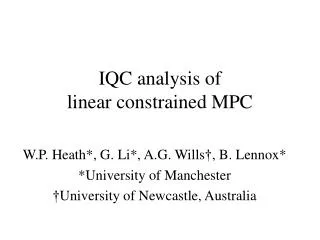
IQC analysis of linear constrained MPC W.P. Heath*, G. Li*, A.G. Wills†, B. Lennox* *University of Manchester †University of Newcastle, Australia
TLAs: • MPC: Model Predictive Control • IQC: Integral Quadratic Constraint Also: • KKT: Karush-Kuhn-Tucker • KYP: Kalman-Yakubovich-Popov • LMI: Linear Matrix Inequality
Overview • IQC theory • Familiar examples • Quadratic programming and sector bounds • Robustness of MPC • Example • Computation • Zames-Falb multipliers
Overview • IQC theory • Familiar examples • Quadratic programming and sector bounds • Robustness of MPC • Example • Computation • Zames-Falb multipliers
Overview • IQC theory • Familiar examples • Quadratic programming and sector bounds • Robustness of MPC • Example • Computation • Zames-Falb multipliers
Overview • IQC theory • Familiar examples • Quadratic programming and sector bounds • Robustness of MPC • Example • Computation • Zames-Falb multipliers
MPC stability We can use IQC theory to test stability of many MPC structures. For example: Remark: there is no requirement for MPC internal model to match the plant
Overview • IQC theory • Familiar examples • Quadratic programming and sector bounds • Robustness of MPC • Example • Computation • Zames-Falb multipliers
So we can combine uncertainty and static nonlinearities: • D represents uncertainty • f represents static nonlinearity
MPC robust stability For MPC we can combine • the quadratic programming nonlinearity • the model uncertainty into a single block satisfying a single IQC. It remains to test the condition on the remaining linear element.
Overview • IQC theory • Familiar examples • Quadratic programming and sector bounds • Robustness of MPC • Example • Computation • Zames-Falb multipliers
Example: • 10 step horizon • 2x2 plant • IQC made up from four separate blocks (two nonlinearities and 2 uncertainties) • Weight on states is 1/k
Overview • IQC theory • Familiar examples • Quadratic programming and sector bounds • Robustness of MPC • Example • Computation • Zames-Falb multipliers
KYP lemma The stability condition is equivalent to an LMI • For MPC: • LMI equation dimension grows linearly with horizon • LMI solution dimension is independent of horizon
Overview • IQC theory • Familiar examples • Quadratic programming and sector bounds • Robustness of MPC • Example • Computation • Zames-Falb multipliers
Multipliers and IQCs • Multipliers allow more general choice of IQC • This in turn leads to less conservative stability results • Natural expression and generalisaiton of (for example): • Commutant sets for structured uncertainty • Nonlinear results such as Popov stability criterion
Zames-Falb multipliers Zames and Falb introduced general class of multipliers (1968) f is - bound - monotone nondecreasing - slope restricted Safanov and Kulkarni considered their application to multivariable nonlinearities (2000) independent of path
Zames-Falb multipliers for quadratic programming Result: Zames-Falb multipliers can be applied to the quadratic programme nonlinearity. Proof: via KKT conditions and convexity. Compare: - Fiacco et al: sensitivity analysis in nonlinear programming - Geometry of multiparametric quadratic programming
Conclusion • IQC theory provides a robust stability test of simple MPC loops (with arbitrary horizon) • We have illustrated the test for a 2x2 system and a 10 step horizon MPC • Current work: • How should we optimise multipliers? • How conservative is the test?