Download
1 / 6
0 likes | 3 Vues
In this guide weu2019ll walk you through each step of the manufacturing process, highlight quality and regulatory considerations, and offer insight into sourcing from U.S.-based operations. Know more https://restorepeptides.io/peptide-manufacturing-guide/

E N D
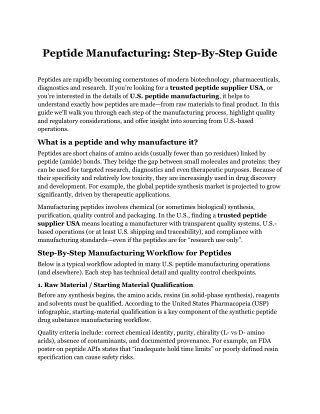
Peptide Manufacturing: Step-By-Step Guide Peptides are rapidly becoming cornerstones of modern biotechnology, pharmaceuticals, diagnostics and research. If you’re looking for a trusted peptide supplier USA, or you’re interested in the details of U.S. peptide manufacturing, it helps to understand exactly how peptides are made—from raw materials to final product. In this guide we’ll walk you through each step of the manufacturing process, highlight quality and regulatory considerations, and offer insight into sourcing from U.S.-based operations. What is a peptide and why manufacture it? Peptides are short chains of amino acids (usually fewer than 50 residues) linked by peptide (amide) bonds. They bridge the gap between small molecules and proteins: they can be used for targeted research, diagnostics and even therapeutic purposes. Because of their specificity and relatively low toxicity, they are increasingly used in drug discovery and development. For example, the global peptide synthesis market is projected to grow significantly, driven by therapeutic applications. Manufacturing peptides involves chemical (or sometimes biological) synthesis, purification, quality control and packaging. In the U.S., finding a trusted peptide supplier USA means locating a manufacturer with transparent quality systems, U.S.- based operations (or at least U.S. shipping and traceability), and compliance with manufacturing standards—even if the peptides are for “research use only”. Step-By-Step Manufacturing Workflow for Peptides Below is a typical workflow adopted in many U.S. peptide manufacturing operations (and elsewhere). Each step has technical detail and quality control checkpoints. 1. Raw Material / Starting Material Qualification Before any synthesis begins, the amino acids, resins (in solid-phase synthesis), reagents and solvents must be qualified. According to the United States Pharmacopeia (USP) infographic, starting-material qualification is a key component of the synthetic peptide drug substance manufacturing workflow. Quality criteria include: correct chemical identity, purity, chirality (L- vs D- amino acids), absence of contaminants, and documented provenance. For example, an FDA poster on peptide APIs states that “inadequate hold time limits” or poorly defined resin specification can cause safety risks.
2. Peptide Chain Assembly – Synthesis The most common method in modern peptide manufacturing is solid-phase peptide synthesis (SPPS), though other routes (solution-phase, liquid-phase) exist. In SPPS, the first (usually C-terminal) amino acid is anchored to a solid resin bead, then sequentially protected amino acids are coupled, deprotected, and extended until the full peptide sequence is assembled. According to an industrial perspective review: “Solid-phase peptide synthesis (SPPS) is generally the method of choice for the chemical synthesis of peptides, allowing routine synthesis of virtually any type of peptide sequence…” Even with SPPS there are variations (e.g., N-to-C direction synthesis) emerging to improve efficiency and sustainability. 3. Cleavage & Crude Peptide Isolation Once the chain assembly is complete, the peptide is cleaved from the resin and protecting groups removed (in the case of SPPS). This yields a crude peptide mixture containing the desired sequence plus by-products (deletions, truncations, incorrectly coupled sequences, etc.). The crude peptide is isolated (precipitated, filtered, washed) and prepared for purification. 4. Purification Purifying the peptide is critical to achieve high purity (commonly >95% for research grade, and higher for pharmaceutical grade). A leading technique is reverse-phase high performance liquid chromatography (RP-HPLC). According to a U.S. manufacturer description: “After synthesis, peptides must be purified … the most common method is HPLC… fractions are collected and tested. Only high-purity material is kept for research use.” Impurities include truncated sequences, side-products, aggregates, and residual reagents. A manufacturing-process overview article states that “peptides are complex molecules with challenging quality and regulatory aspects… manufacturing, in-process controls, impurities and aggregates arising from manufacturing and storage” need to be carefully managed. 5. Quality Control (QC) & Release Testing Once purification is complete, rigorous testing ensures identity, purity, sterility (if required), absence of endotoxins or heavy metals, and stability. Common tests: mass spectrometry (to confirm molecular weight/sequence), analytical HPLC for purity, amino acid analysis, residual solvent testing, chiral analysis (ensuring L-amino acid content) and stability under defined conditions.
For manufacturers marketing themselves as a trusted peptide supplier USA, documentation such as Certificate of Analysis (COA), batch records, traceability of raw materials, and manufacturing location transparency are important indicators. 6. Lyophilization, Packaging & Storage After QC pass, the peptide is often lyophilized (freeze-dried) to produce a stable powder. Packaging in sealed vials, inert atmosphere or desiccant may be used. Labelling typically includes peptide name/sequence, lot number, purity, storage instructions and “For Research Use Only (RUO) – Not for human use” disclaimer if applicable. Packaging should protect from moisture, light, and maintain chain of custody. Storage conditions (e.g., −20°C, protected from moisture) are indicated and shelf life or reconstitution instructions provided. 7. Shipping & Supply Chain Considerations For a U.S. peptide manufacturing facility or supplier, domestic shipping means faster turnaround, fewer customs delays, and potentially better regulatory traceability vs overseas sourcing. Many U.S.-based suppliers emphasise “all peptide production in the United States … tighter oversight of manufacturing and quality standards.” However, note that “U.S. produced” can sometimes mean U.S. packaging or final steps rather than entire raw material/manufacture chain—buyers should ask for full transparency. 8. Regulatory & Quality Framework While many peptides for research use may not be regulated as drugs, the manufacturing should still follow good manufacturing practice (GMP) or at least GMP-like standards if the supplier markets high-quality materials. An article on control strategies for synthetic peptide APIs emphasises that “robust control strategies … throughout the manufacturing process … to produce consistently high-quality peptide drugs.” Moreover, for therapeutic peptides, regulatory agencies expect demonstration of impurity control, enantiomer purity, consistent manufacturing, and stability data. Sustainability is also becoming a factor: solvent usage in SPPS is high, and efforts are underway to reduce environmental footprint in U.S. peptide manufacturing. Why Choosing a Trusted Peptide Supplier USA Matters When you source peptides for research (or other applications), choosing a U.S.-based supplier with manufacturing transparency offers several advantages: Traceability: Raw materials, batch records and certificates can be more accessible.
Shipping/Logistics: Domestic shipping reduces customs delays or import complications. Quality oversight: U.S. regulatory environment tends to favour stricter manufacturing oversight. Customer support: Being local may mean more responsive technical support and clearer regulatory disclaimers. That said, always confirm: Are the peptides really manufactured in the U.S., or just packaged there? Are COAs, purity analyses, and batch records available? Are they clearly labelled for “research use only” if applicable? Common Challenges in U.S. Peptide Manufacturing Manufacturing peptides at scale is not trivial, as companies have documented: Complexity of synthesis of longer peptides, or those with modifications (non- canonical amino acids) and purification challenges. High reagent and solvent cost, especially for specialized resins and coupling agents. Process mass intensity and environmental burden from large-scale SPPS workflows. Regulatory demands for impurity control, process validation and consistency (especially for therapeutic peptides). If a supplier claims to be a U.S. manufacturer but cannot provide transparency into their process, purity, or traceability, those are red flags. Final Note If you’re sourcing peptides for research and want to work with a U.S.-based manufacturer or supplier, focus on transparency, documented quality, manufacturing traceability, and clarity around usage. While many marketed peptides are high purity and suitable for lab use, the jump from “research-grade” to “human use” involves entirely different regulatory, manufacturing and safety standards. Keep your procurement process rigorous, ask the right questions, and don’t rely solely on marketing claims. Summary Peptide manufacturing—especially when done by a trusted peptide supplier USA under U.S. peptide manufacturing practices—involves a multi-step workflow from raw material qualification, synthesis (typically solid-phase), cleavage, purification, QC, lyophilization, packaging and shipping. Each step demands rigorous control to ensure
quality, identity, purity and stability. For researchers and institutions, choosing a U.S.- based supplier with clear documentation, traceability, and quality assurances makes a meaningful difference. But always remain aware of the distinction: “research use only” vs therapeutic grade, and ask for full transparency before committing. Frequently Asked Questions (FAQ) 1. What does “trusted peptide supplier USA” actually mean? A trusted peptide supplier USA typically indicates a company that sources and/or manufactures peptides within the United States (or at least handles final manufacturing and packaging domestically), provides COAs, batch records, traceability of raw materials, clearly labels “for research use only”, and offers technical support. You should still verify their manufacturing location, purity, and documentation. 2. What is the difference between U.S. peptide manufacturing and overseas manufacturing? U.S. peptide manufacturing may offer shorter shipping time, domestic regulatory oversight, and potentially better traceability. However, even U.S. suppliers may source raw materials or do final processing overseas. Always check whether manufacturing is truly U.S.-based, what quality systems are used, and whether the peptides are intended for research use only or therapeutic use. 3. What is SPPS and why is it important for peptide manufacturing? Solid-Phase Peptide Synthesis (SPPS) is the predominant technique for synthetic peptide manufacturing—especially for research/therapeutic peptides. It allows the peptide chain to be built step-by-step on a solid resin support, facilitating automation, sequence control and purification steps. 4. How can I assess the quality of a peptide from a U.S. supplier? Check for the following: Certificate of Analysis (COA) showing >95% purity or whatever purity is claimed; Mass Spectrometry (MS) verification of correct sequence and molecular weight; HPLC trace showing purity; information on starting materials and manufacturing process; packaging and labelling indicating lot number, storage conditions and “research use only” statement; and documentation of manufacturing location (U.S. vs overseas). Also ask whether the supplier follows GMP or GMP-like standards if you need higher quality. 5. Are peptides from U.S. manufacturers safe for human use? No — the manufacturing of peptides by a U.S. supplier for research use does not imply they are approved for human use. Many peptides are labelled “for research use only” (RUO) and are not FDA-approved therapeutic products. If human use is intended, regulatory status, manufacturing under GMP, sterility, endotoxin testing and clinical documentation must be considered. Always consult regulatory and medical professionals before any human use.
References Peptide synthesis: a review of classical and emerging methods. (PubMed) Building parity between brand and generic peptide products: Regulatory and scientific considerations for quality of synthetic peptides. (PubMed) Greening the synthesis of peptide therapeutics: an industrial perspective. (PubMed) Step-by-step guide to peptide synthesis and manufacturing: From discovery to production. (Sterling Pharma Solutions) How Peptides Are Made | U.S. Peptide Synthesis – PeptideTech. (Peptide Tech) Control Strategies for Synthetic Therapeutic Peptide APIs: Manufacturing Process Considerations. (Pharmaceutical Technology) Peptide Synthesis Market Size, Share | Industry Report. (Grand View Research) Know more https://restorepeptides.io/peptide-manufacturing-guide/






![[DOWNLOAD] Marketing Made Simple: A Step-By-Step Storybrand Guide for Any Business Full](https://cdn5.slideserve.com/11106317/slide1-dt.jpg)