Understanding Electrochemistry: Redox Reactions and Metal Activity Series
This guide explores the fundamentals of electrochemistry, focusing on redox reactions where electron transfer occurs between reactants. It defines key concepts such as oxidation (loss of electrons) and reduction (gain of electrons), and introduces the mnemonic "LEO says GER" to remember these processes. The activity series of metals is constructed experimentally to predict spontaneous reactions. Specific examples, including half-reactions and net ionic equations, illustrate oxidation and reduction, highlighting the interactions between metals like copper and silver.

Understanding Electrochemistry: Redox Reactions and Metal Activity Series
E N D
Presentation Transcript
Understand Redox reactions involve a transfer of • electrons. • Develop a metals activity series experimentally. • Predict spontaneous reactions using an activity • series.
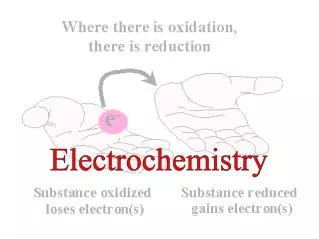
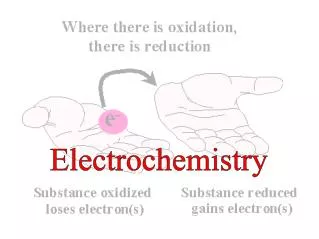
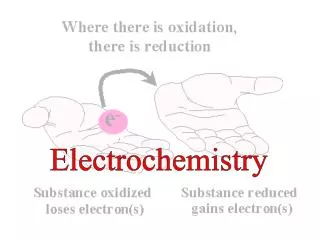
Burning and corrosion needs oxygen – oxidation. Oxidation-reduction reactions – (redox) Chemical changes when electrons are transferred from one reactant to another. Oxidation - an atom loses one or more electrons. Reduction- an atom gains one or more electrons. "LEO says GER” Losing Electrons is Oxidation, Gaining Electrons is Reduction
2 Ag+(aq) + Cu(s) ?? Atoms fight for electrons. The strongesttakes electrons from other substance. Strongest is reduced (gains), weakest is oxidized (loses). Metals do not gain electrons and are always oxidized.
2 Mg (s) + O2 (g) → 2 MgO (s) Mg – neutral Mg2+ ion O – neutral O2– ion Magnesium is . Oxygen is reduced. O + 2e- → O2- Mg → Mg2+ + 2e- These are called “half-reactions.”
Half-reactions show the oxidation or reduction reaction separated. +1 +2 0 0 Cu(s) + 2 AgNO3(aq) → Cu(NO3)2(aq) + 2 Ag(s) Oxidation: Cu → Cu2+ + 2e– Reduction: Ag+ + 1e– → Ag Half reactions are often shown as aqueous net ionic equations – spectator IONS not included.
Spontaneous rxns occurs without added energy. 2 Ag+(aq) + Cu(s) → Ag(s) + Cu2+(aq) → 2 Ag(s) + Cu2+(aq) no reaction Ag+ions can oxidizeCu metal. Cu2+cannot oxidize Ag metal. Cu metal can reduce Ag+ ions. Ag metal cannot reduce Cu2+ ions.