Exploring Non-Perturbative QCD with CLEO-c: Uncovering Exotic States and Spectroscopy
160 likes | 275 Vues
This study by S. Dytman from the University of Pittsburgh, part of the CLEO collaboration, investigates the complexities of Quantum Chromodynamics (QCD) and its implications for strong interactions. Despite significant progress in spectroscopy, crucial states remain missing or unconfirmed. The focus is on discovering exotic states through advanced lattice calculations and empirical quark models, alongside measurements of charmonium and bottomonium spectra. CLEO-c aims to provide essential insights into hybrid mesons, glueballs, and decay processes to enhance the understanding of strong forces at larger distances.


Exploring Non-Perturbative QCD with CLEO-c: Uncovering Exotic States and Spectroscopy
E N D
Presentation Transcript
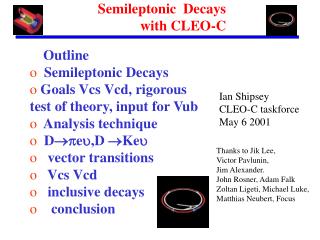
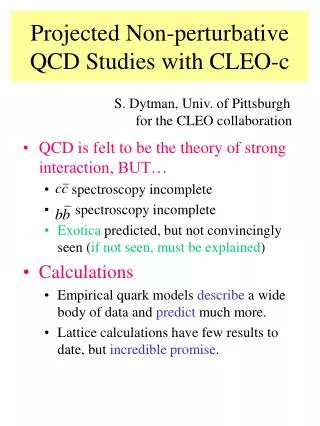
Projected Non-perturbative QCD Studies with CLEO-c S. Dytman, Univ. of Pittsburgh for the CLEO collaboration • QCD is felt to be the theory of strong interaction, BUT… • spectroscopy incomplete • spectroscopy incomplete • Exotica predicted, but not convincingly seen (if not seen, must be explained) • Calculations • Empirical quark models describe a wide body of data and predict much more. • Lattice calculations have few results to date, but incredible promise.
What is missing? • Missing or unconfirmed states • hc’, hc, hb, hb, L≥2 states • Poorly known information • widths, ee coupling, form factor • states at mass >4.0 GeV • Only strong hints of exotica so far • Glueballs ( ) • Hybrid mesons- light quark(pp,pp), charm(?), bottom(?) • Incomplete R data affects (g-2)m, a(MZ)…
Predictions for charmed hybrid meson Mass: Juge, Kuti, & Morningstar (’99) 4.24 GeV CP-PACS (’99) 4.39(.1) GeV MILC (’99) 4.27(.15) GeV MILC (’97) 4.39(.08)(.20) GeV Barnes et al. (’95) Flux tube 4.1-4.2 Decays: Flux tube partial widths (MeV) for M=4.4 GeV Page, Swanson, Szczepaniak (’99) Production: Direct via e+e-Gee~1 keV Decay from (1S) BR~10-3 Quenched lattice via e+e- exotic Estimates by Close and Swanson
Lattice QCD Advances • Improved actions • Better understanding of corrections • Anisotropic lattice • Faster, bigger, cheaper computers e.g. calculation of glueball spectrum by Morningstar & Peardon
CLEOIII collaboration • Albany • CalTech • Carnegie Mellon • Cornell • Florida • Harvard • Illinois • Kansas • Minnesota • Oklahoma • Ohio State • Pittsburgh • Purdue • Rochester • SMU • Syracuse • UTPanAmerican • Vanderbilt • Wayne State 19 institutions ~160 physicists collaboration looks to be largely intact for CLEO-c
Near-Term Upsilon Studies with CLEOIII • Proposalunder consideration for >4 fb-1 • emphasize (1S), (2S), (3S) • inclusive exotic search • hb, hb via g, hadronic transitions) Measured Possible? ↑ ↑ ↑ ↑ ↑ ↑ ↑ ↑ hb hbcb ? ? ? ?
CLEOII inclusive spectrum + theory (Godfrey/Rosner)for (3S)→g hbdecays
The tough life of the fJ(2220)(A case study) Sometimes it is clear… BES (1996) MARKIII (1986)
Other times, not so clear ?? LEAR (1998) L3 (1997) pp→hh excitation scan OPAL (1998) L3 Signal
fJ(2220) in CLEO-c? BES CLEO-C p+p- 74 32000 p 18 13000 K+K- 46 18600 KSKS 23 5300 pp 32 8500 – 5000 Multiple directions of attack: • Glueball anti-search with gg Data: • CLEO II: B fJ +-/KSKS < 2.5(1.3) eV • CLEO III: sub-eV sensitivity • (1S) decays:Tens of events • Solid PWA of Critical Importance
Inclusive Spectrum(Monte Carlo) • spectrum from J/y X: • 10-4 sensitivity for narrow resonance • Efficiency for fJ(2220) ~25% • CLEO-c has excellent suppression of hadronic bkg: J/X • 10-4 sensitivity for narrow resonance • Eg: ~25% efficient for fJ(2220) • Suppress hadronic bkg: J/X
Comparison with Other Expts China: BES II is running now. BES II → BES III upgrade proposed BEPC I → BEPC II upgrade, ~1032 lum. proposed Physics after 2005 if approval & construction go ahead. • HALL-D at TJNAL: • Use gp to produce hybrid mesons with exotic Quantum Numbers • Focus on light states with JPC= 0+-, 1-+, … • Complementary to CLEO-C focus • light glueballs with JPC=0++, 2++, … • heavy hybrid mesons • Physics in 2007+ ?
Conclusions • Much to learn in QCD at large distance • Strong coupling field theory • One of the cutting edges of physics • Many advances in theory expected (esp. lattice QCD) • CLEO-c can provide many ground-breaking measurements • spectroscopy • spectroscopy • J/y decays (glueballs?) • R measurements • D absolute decay rates, form factors • …….