Harmonic Motion
This overview explores the principles of harmonic motion and uniform circular motion, describing how each can be analyzed using components. The equations for position, velocity, and acceleration are detailed, illustrating their relationships in circular motion through angular velocity. The text explains the sinusoidal nature of harmonic motion, with examples such as springs and pendulums, and how forces are linked to acceleration. A practical application of finding the spring constant of a diving board oscillating with a given frequency and mass is also included.

Harmonic Motion
E N D
Presentation Transcript
Circular motion can be described by components. x = r cos q y = r sin q For uniform circular motion the angle is related to the angular velocity. q = wt The motion can be described as a function of time. x = r cos wt y = r sin wt Vector Components r r sin q q r cos q
Velocity Components • The velocity vector can also be described by components. • vx = -v sin q • vy = v cos q • This is the derivative of the position. v v cos q q -v sin q q
Acceleration Components • For uniform circular motion the acceleration vector points inward. • ax = -a cos q • ay = -a sin q • This is the derivative of the velocity. -a cos q q a -a sin q q
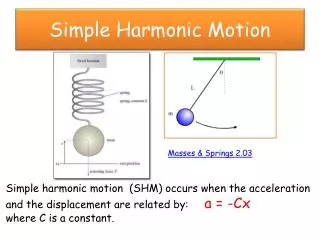
1 period Changing Angle to Position • If only one component is viewed the motion is sinusoidal in time. • This is called harmonic motion. • Springs and pendulums also have harmonic motion. x = A cos wt
Acceleration and Position • In uniform circular motion acceleration is opposite to the position from the center . • In harmonic motion the acceleration is also opposite to the position. This is true for all small oscillations
From the law of action the force is proportional to the acceleration. Harmonic motion has a position-dependent force. Force is negative Restoring force Spring Oscilations
Springboard • A diving board oscillates with a frequency of 5.0 cycles per second with a person of mass 70. kg. What is the spring constant of the board? • Find the spring constant from the mass and frequency. • With values: • k = 42(5.0 /s)2(70. kg) • K = 6.9 x 10⁴ N/m next