Understanding Oxidizers and Redox Reactions
This lesson focuses on identifying redox reactions, exploring key concepts like oxidizing and reducing agents. Students will learn to determine whether a reaction is redox by analyzing oxidation states before and after the process. Examples will illustrate how substances gain or lose electrons, with practice problems to solidify understanding. By the end of the session, students should be equipped to identify oxidizing agents and reducing agents and understand their roles in chemical reactions.

Understanding Oxidizers and Redox Reactions
E N D
Presentation Transcript
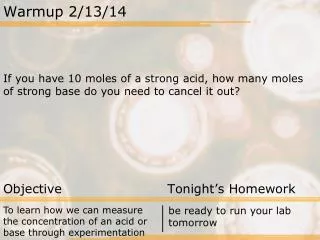
Warmup2/26/14 What is an oxidizer again? Oxidizers are usually very reactive. Why do you think this is? Objective Tonight’s Homework To learn how to identify redox reactions Finish Worksheet
Notes on Identifying Redox Reactions With the last lesson or two, we’re more equipped to identify redox reactions. Let’s review the rules we’ve said and do a bit of practice as a class.
Notes on Identifying Redox Reactions With the last lesson or two, we’re more equipped to identify redox reactions. Let’s review the rules we’ve said and do a bit of practice as a class. 1) An oxidizing agent: This is the substance in the reaction that will gain electrons. 2) A reducing agent: This is the substance in the reaction that will lose electrons. These are always reactants, not products. We can tell if something has lost or gained electrons based on oxidation number before and after the reaction.
Notes on Identifying Redox Reactions Example: Determine whether the reaction below is redox or not. If it is redox, identify the oxidizing and reducing agents. C H4(g) + 2O2(g) C O2(g) + 2H2 O(g)
Notes on Identifying Redox Reactions Example: Determine whether the reaction below is redox or not. If it is redox, identify the oxidizing and reducing agents. C H4(g) + 2O2(g) C O2(g) + 2H2 O(g) Rule 4 for hydrogen, Rule 6 for carbon Rule 1 Rule 3 for oxygen, Rule 3 for oxygen, Rule 6 for carbon Rule 4 for hydrogen -4 +1 0 +4 -2 +1 -2
Notes on Identifying Redox Reactions C H4(g) + 2O2(g) C O2(g) + 2H2 O(g) Ok. So is this redox? Let’s look at carbon. On the left side, C has an oxidation of -4. On the right side, C has an oxidation of +4. This is redox. - CH4 is the reducing agent. It lost electrons. - O2 is the oxidizing agent. It gained electrons. -4 +1 0 +4 -2 +1 -2
Practicing Identifying Redox Reactions Let’s practice redox reactions. For each of the reactionson the worksheet, do the following: - Identify whether or not the reaction is redox - List the oxidation number for each element - Identify the oxidation and reduction agents
Practicing Identifying Redox Reactions 1) 2Na + FeCl2 2NaCl + Fe 2) 2C2H2 + 5O2 4CO2 + 2H2O 3) 2PbS + 3O2 2SO2 + 2PbO 4) 2H2 + O2 2H2O 5) Cu + HNO3 CuNO3 + H2 6) AgNO3 + Cu CuNO3 + Ag
Exit Question #24 What is the oxidizing agent? a) The substance that will lose electrons b) The substance that will gain electrons c) The substance that has lost electrons d) The substance that has gained electrons e) It depends on the reaction f) None of the above