Understanding Central Tendency: Mode, Median, and Mean Explained
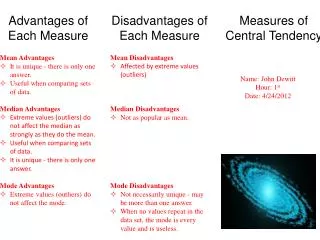
Central tendency refers to statistical measures that summarize data sets by identifying the central point within that distribution. Key measures include the mode, which is the most frequently occurring value, the median, which is the middle value when data is organized in order, and the mean, which represents the average score. This concept is visually represented by the mean, where distances from this average are equal on both sides. In a normal distribution, these measures coincide, whereas, in skewed distributions, they differ significantly.

Understanding Central Tendency: Mode, Median, and Mean Explained
E N D
Presentation Transcript
Central Tendency • Central Tendency – measures of location for a distribution • Mode – the commonly occurring number in a data set • Median – the middle score in a distribution • Mean – the average score
Visual Representation of the Mean • The numerical distance of scores below the mean is always equal to the numerical distance of scores above the mean
Skew and Central Tendency • For a normal distribution, all measures of central tendency are equal • For a skewed distribution, the measures of central tendency are different