Download
1 / 14
140 likes | 256 Vues
This study delves into the observation and modeling of far-infrared (FIR) galaxies, focusing on luminous and massive galaxies. Utilizing data from Spitzer and Herschel, we explore the evolution and formation of galaxies at redshifts (z) ~2 and beyond. We highlight the challenges in detecting high-z galaxies and the importance of larger facilities like CCAT for deeper surveys. Our analysis includes the spectral energy distributions (SEDs) and counts from various bands, aiding our understanding of star formation history and the cosmic infrared background (CIB).

E N D
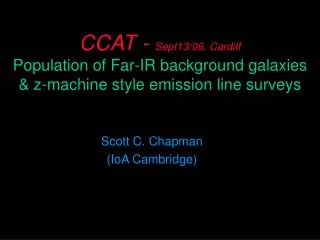
CCAT - Sept13/06, CardiffPopulation of Far-IR background galaxies& z-machine style emission line surveys Scott C. Chapman (IoA Cambridge)
Galaxy Evolution:Where are we, where do we go? 1) Currently only scratching the surface of luminous/massive galaxies (Spitzer and Herschel are/will help considerably) -still unsure if we have census of all z~2 luminous galaxies 2) To really understand galaxy formation and evolution (<M* galaxies), we need larger facilities. -finding the hyper-luminous peaks in different bands not enough.
Counts and Models 24um • Old models (Dole+, Chary/Elbaz, Chapman/Lewis, etc.) easily fit data • Spitzer forced refinements to models (eg., Lagache+04) • -strength of aromatics/PAHs, range of SEDs for a given luminosity • -epoch dependent density and luminosity evolution
N(z) Spitzer and submm galaxies 15um/24um hump at z~1 from 6-9um/11-14um aromatics also z~2 hump in 24um from 6-9um aromatics? (Chapman,Lewis,Helou 2003, 2005 model predictions) K-corrections mean that 15/24/850 probe CIB in well-defined, and distinct z ranges: z=0.7 (15um), z=1.1 (24um), z=2.3 (850um)
Components of FIRB (SCUBA2 and CCAT) 350 850 Dole et al. 2005 Submm is almost all high-z galaxies (80% z<4) MidIR and FarIR is 80% z<1.7 SMM best (only?) way to probe the high-z components of FIRB
SCUBA contribution to mm/FIRB • >0.5mJy SCUBA population produces 80-100% of 850um background • CCAT territory! • Median redshift of bright SMGs is z~2.3 • Fit dust SEDs to radio/850um at known z • 850um population produces bulk of the >400um FIRB Corrected for <5mJy sources >5mJy Arp220 SED >5mJy fitted SMG SEDs
The Star Formation History of the Universe • X-ray & extended-radio => SCUBA galaxies not dominated by AGN • interpret far-IR luminosities in terms of star formation (30% AGN) • SMGs are the main site of massive star formation at z>2 • UV galaxies evolve differently from SCUBA galaxies • Balance between obscured and unobscured SF has shifted drastically in last 80% THub UV-selected L* ? SCUBA Spitzer -- SPICA/BLISS, ALMA, LMT, CCAT25 (Chapman et al. 2004)
Confusion Currently impossible to probe high-z galaxies in FarIR! Nowhere near probing IR morphologies
Submm/FIR Continuum: CCAT deep surveys… Bivariate LF (Chapman+03) to model Td distribution. 200 350 600 850 850 160
Molecular/Fine Structure emission lines 6x15m IRAM PdB Interferometer • Molecular gas defines sites of star formation • IRAM-PdBI Needs precise redshifts (500Mhz band) • 30 SMGs observed, 18 detected in CO • (Neri et al. 2003, Greve et al. 2005, Tacconi et al. 2005) CO(3-2)
Longest baselines: Hi-Res CO studies (Tacconi et al. 2005)
Fine Structure Lines: COLD, 3.5m aperture ULIRG Cii CCAT/z-spec
Simulation of all galaxies in 1’ beam: -Bivariate LF : emission line templates matched to Arp220 or M82 based on dust temperature. -14 brightest galaxies contribute the bulk of the detectable lines. -CCAT targeted low-res spectroscopy could survey large numbers of obscured galaxies for redshifts, line strengths and ratios.