2.4 Rates of Change and Tangent Lines
2.4 Rates of Change and Tangent Lines. Calculus. Finding average rate of change. Find the average rate of change of over the interval [1, 3]. 12. Slope of a secant line. Use points P(23, 150) and Q(45, 340) to compute the average rate of change and the slope of the secant line PQ.


2.4 Rates of Change and Tangent Lines
E N D
Presentation Transcript
Finding average rate of change • Find the average rate of change of over the interval [1, 3]. • 12
Slope of a secant line • Use points P(23, 150) and Q(45, 340) to compute the average rate of change and the slope of the secant line PQ. • 8.6 flies/day • We can always think about average rate of change as the slope of a secant line.
Instantaneous rate of change • What about the growth of the population on day 23? We move point Q closer to point P to get a better estimate. • Notice the secant line appears to be approaching the tangent line. • So we could use the slope of the tangent line as the instantaneous rate of change at
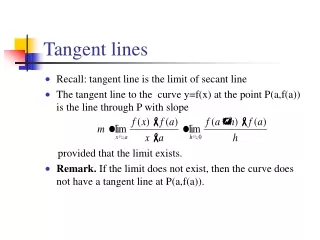
Steps for finding the slope of the tangent • Start with what we can calculate- the slope of the secant through a point P and a point nearby (Q) on the curve. • Find the limiting value of the secant slope (if it exists) as Q approaches P along the curve. • Define the slope of the curve at P to be this number and define the tangent to the curve at P to be the line through P with this slope.
Definition: Slope of a curve at a point • The expression is the difference quotient of f at a.
Example: Finding slope and tangent line • Find the slope of the parabola at the point P(2, 4). Write an equation for the tangent to the parabola at this point.
Example: • Find the slope of the curve at . • Where does the slope equal -1/4?
Lines normal to a curve • The normal lineto a curve at a point is the line perpendicular to the tangent at that point. • Write an equation for the normal to the curve at
Free fall…again • Find the speed of the falling rock (discussed earlier in this chapter) at sec. • Remember: • 32 ft/sec