
Investigating Earthquake Propagation in Branched Fault Systems Using 3D Finite Element Method
This study explores the stress interactions and earthquake propagation within branched fault systems. Utilizing the 3D finite element method, we analyze how earthquakes can propagate from a basal fault to upper branches based on specific geometrical configurations. Our findings indicate that rupture propagation occurs across the entire fault system primarily when a barrier exists on the upper vertical fault, covering an area of approximately 20-24 km². Various models have been tested to elucidate these dynamics, revealing significant insights into fault behavior.

Investigating Earthquake Propagation in Branched Fault Systems Using 3D Finite Element Method
E N D
Presentation Transcript
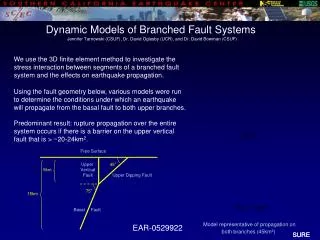
Dynamic Models of Branched Fault Systems Jennifer Tarnowski (CSUF), Dr. David Oglesby (UCR), and Dr. David Bowman (CSUF) We use the 3D finite element method to investigate the stress interaction between segments of a branched fault system and the effects on earthquake propagation. Using the fault geometry below, various models were run to determine the conditions under which an earthquake will propagate from the basal fault to both upper branches. Predominant result: rupture propagation over the entire system occurs if there is a barrier on the upper vertical fault that is > ~20-24km2. Free Surface Upper Vertical Fault 45° 5km Upper Dipping Fault 75° 15km Click on video Basal Fault Model representative of propagation on both branches (45km2)