Download
1 / 9
90 likes | 209 Vues
The Biodiversity and Ecosystem Services (BES) NetDialogue Workshop held on April 11-13, 2012, in Usdub, Guna Yala, Panama, aimed to connect policymakers, scientists, and implementers. The workshop emphasized the importance of integrating diverse knowledge systems, including traditional knowledge, to influence policy and enhance scientific research. Key discussions focused on capacity building, the science-policy interface, and the engagement of local communities and indigenous peoples. BES-Net strives to promote best practices, enhance capacity in developing countries, and facilitate access to relevant data and tools for effective implementation.

E N D
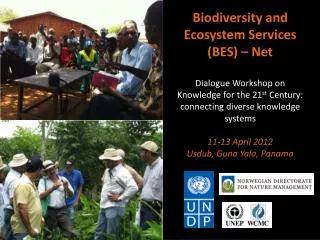
Biodiversity and Ecosystem Services (BES) – NetDialogue Workshop on Knowledge for the 21st Century: connecting diverse knowledge systems11-13 April 2012Usdub, Guna Yala, Panama
Connecting policy makers, scientists and implementers Policy makers Scientists Implementers
Policy Science Implementation • Importance of diverse including traditional knowledge • To influence policy-making • To feed into scientific research
Policy • Need for accessible info on relevant policy and science • Relevant for implementation • In appropriate languages • In usuable media / formats Science Implementation
IPBES discussions on capacity building • Calls from developing countries for emphasis in IPBES on capacity building • Big emphasis on science-policy interface • Need also to involve local communities and indigenous peoples
Capacity needs identified by IPBES Knowledge generation: using science in decision-making Assessments: carrying out sub-global assessments Policy support tools & methodologies: capacity to ensure efficient and effective use • Access to data, information and knowledge for doing assessments and using policy tools • Engagement of policymakers, scientists, experts and communities
Initial partners • United Nations Development Programme - UNDP • UNEP World Conservation Monitoring Centre - (UNEP-WCMC • Norwegian Government • interim secretariat established by the Directorate for Nature Management, Ministry of Environment • Other potential partners: governments, NGOs, agencies • Centres of excellence in developing cuntires
BES-Net objectives • To enable sharing of learning and best practice between and within the science, policy and implementation communities • To build developing country capacity to identify and prioritize key scientific information and diverse knowledge needed • To promote and support national and regional assessments, and to build developing country capacity to contribute to global and thematic assessments • To build capacity to develop and use policy support tools and methodologies, and improve access to data, information, scientific literature and diverse knowledge
BES-Net: two parts A. Web Portal B. Face-to-face Networking Activities • Global workshops on stakeholder capacity building needs • Peer-to-peer exchange visits • Regional science-policy-practice dialogue events • National and sub-national training workshops