Empirical Method for Automated Software Process Discovery Using Trajectory Analysis
This study presents an empirically-based method for automated software process discovery utilizing trajectory analysis. It focuses on capturing habits in telemetry through techniques such as Dynamic Time Warping (DTW) and Longest Common Subsequence (LCS). This method aims to improve software development processes by analyzing time series data with approaches like sliding windows and clustering. The research is conducted by Pavel Senin at the University of Hawaii, supervised by a committee of experts in the field.

Empirical Method for Automated Software Process Discovery Using Trajectory Analysis
E N D
Presentation Transcript
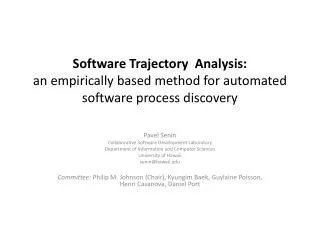
Software Trajectory Analysis:an empirically based method for automated software process discovery Pavel Senin Collaborative Software Development Laboratory Department of Information and Computer Sciences University of Hawaii senin@hawaii.edu Committee: Philip M. Johnson (Chair), KyungimBaek, Guylaine Poisson, Henri Casanova, Daniel Port
“Flexible” metrics Dynamic Time Warping, DTW (Sakoe, H. and Chiba, S., 1978) Longest common subsequence, LCS (David Maier, 1978) Time series indexing Sliding window + L2, DTW or LCS