Enhancing Physics Education: Utilizing Technology to Visualize Concepts in Classroom Demonstrations
This master’s thesis by Jonas Engkvist at the IT University of Gothenburg explores how technology can enhance the teaching of physics, particularly through classroom demonstrations. It examines the effectiveness of traditional classroom education versus laboratory sessions, analyzing aspects of authenticity, activity level, and competence development. By focusing on videotaped demonstrations of mechanics for engineering students, the study employs an ethnomethodological approach to reveal how teachers utilize various technologies to make physics practical and visible. Insights highlight the balance between engagement and educational effectiveness.

Enhancing Physics Education: Utilizing Technology to Visualize Concepts in Classroom Demonstrations
E N D
Presentation Transcript
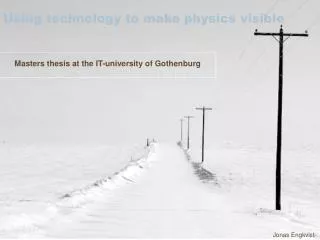
Using technology to make physics visible Masters thesis at the IT-university of Gothenburg Jonas Engkvist
How is physics usually taught? • Classroom education • Laborations
Classroom education vs Labs • Authenticity? • Activity? • Competence? • Economics?
Classroom education • Poor authenticity • Poor activity • Easy to focus on the competence one wish for • Relatively cheap
Labs • High authenticity • High activity • No guarantee for the intended competence • Requires a lot of expensive guidance and equipment
Classrom demonstrations? • High authenticity • High activity • Focus on intended competence • Relatively cheap, only requires one set of lab equipment
The study • Videotaped Classroom demonstrations of mechanics for university engineer students • Etnomethodologically inspired analysis (Livingston, Garfinkel, Goodwin, MacBeth, Lynch) • Focus on how the teacher makes physics as a practical work visible to the students, using several technologies