Impact of Exercise Training on Mortality Rates and Hospitalizations in Systolic CHF Patients
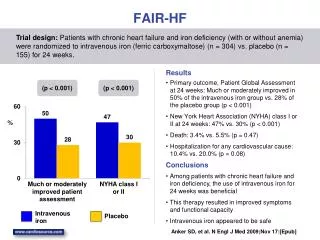
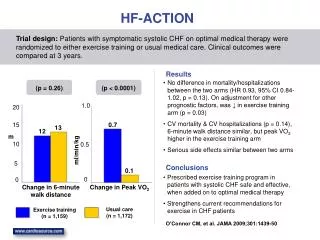
Study comparing outcomes of exercise training vs. usual care in symptomatic systolic CHF patients on optimal medical therapy over 3 years. No significant difference in mortality/hospitalizations, but exercise arm showed decreased CV mortality, higher peak VO2, and safe profile. Strengthens recommendations for exercise in CHF patients.

Impact of Exercise Training on Mortality Rates and Hospitalizations in Systolic CHF Patients
E N D
Presentation Transcript
HF-ACTION No difference in mortality/hospitalizations between the two arms (HR 0.93, 95% CI 0.84-1.02, p = 0.13). On adjustment for other prognostic factors, was ↓ in exercise training arm (p = 0.03) CV mortality & CV hospitalizations (p = 0.14), 6-minute walk distance similar, but peak VO2 higher in the exercise training arm Serious side effects similar between two arms (p = 0.26) (p < 0.0001) Usual care (n = 1,172) Exercise training (n = 1,159) Trial design: Patients with symptomatic systolic CHF on optimal medical therapy were randomized to either exercise training or usual medical care. Clinical outcomes were compared at 3 years. Results 1.0 20 15 0.7 13 12 m 10 0.5 ml/min/kg 5 Conclusions 0.1 • Prescribed exercise training program in patients with systolic CHF safe and effective, when added on to optimal medical therapy • Strengthens current recommendations for exercise in CHF patients 0 0 Change in 6-minute walk distance Change in Peak VO2 O’Connor CM, et al. JAMA 2009;301:1439-50