Accounting Basics and Terms
accounting basics and terms

Accounting Basics and Terms
E N D
Presentation Transcript
CONTENT… Content…. • What is Business Accounting? • Business Accounting Basics. • Business Accounting Terms to Know: • Accounts Receivable & Payable. • Accruals • Assets • Burn Rate • Capital • Cost of Goods Sold • Depreciation • Equity • Expenses • Fiscal Year • GAAP • Liabilities • Profit • Revenue • Gross Margin
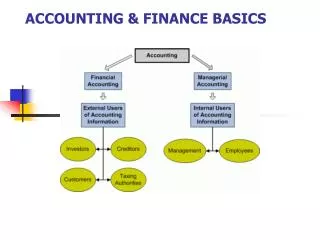
Definition- Resume What is Business Accounting? What is “Networking”? • Accounting is the systematic recording, analysis and interpretation of financial data in your company. • Accounting allows business owners to keep track of their financial operations, comply with legal duties and make better business decisions. • Accounting is an crucial aspect of running a business. • It's a task that you'll have to either master or outsource — or both. • Let's get started by going through some of the accounting terms.
Definition- Resume Business Accounting Basics What is “Networking”? • An Income Statement is a financial statement that reveals how profitable your firm is and how much money it has gained or lost. • A Balance Sheet is a snapshot of your company's financial standing at a specific point in time that displays your company's retained earnings. • A Profit And Loss (P&L) Statement is a snapshot of your company's income and expenses over a period of time. • A Cash Flow Statement is a financial statement that examines your company's operational, financing and investment activities to show how and where money is received and spent. • A Bank Reconciliation compares your cash expenditures with your total bank statements and assists in maintaining consistency in your business records.
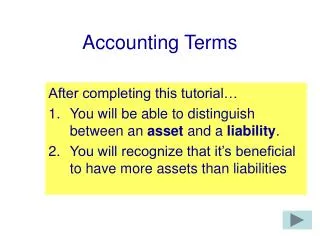
Definition- Resume Business Accounting Terms to Know What is “Networking”? These terms will serve as the foundation for your understanding of business accounting. 1).Accounts Receivable & Accounts Payable. • Accounts receivable is money that individuals owe you for products and services. It is considered an asset on your balance sheet. • Accounts payable refers to money you owed to others and is shown as a liability on your balance sheet. 2). Accruals • Accruals are debts and credits that you've documented but haven't paid off yet. • These could be sales that you've completed but haven't yet received money for or expenses that you've done but haven't yet been paid for.
Definition- Resume Business Accounting Terms to Know What is “Networking”? 3). Assets • Anything that your company owns is referred to as assets whether tangible or intangible. • Cash, tools, property, copyrights, patents and trademarks are all examples of assets. 4).Burn Rate • Your burn rate is the rate at which your company spends money. When it comes to calculating and managing your cash flow, this is an major factor to consider. • To calculate your burn rate, simply choose a time period (like a quarter or a year). • Subtract your cash-on-hand at the ending of the term from your cash-on-hand at the beginning, then divide it by the number of months in the term.
Business Accounting Terms to Know Networking Gets You Hired 5).Capital • Capital refers to the money you have to invest or spend on expanding your firm. • Commonly known as "working capital", refers to money that can be accessed (such as cash in the bank) excluding assets and liabilities. 6). Cost of Goods Sold (COGS) • COGSor cost of sales (COS) is the price you pay to make a product or provide a service. • COGS is the first expense on your profit and loss (P&L) statement and is a crucial component in determining your company's gross margin. • You can enhance profit without increasing sales by lowering your COGS.
Business Accounting Terms to Know Networking Gets You Hired 7). Depreciation • Depreciation refers to the decrease in your asset’s values over time. • It’s is crucial for tax purposes, because larger assets that impact your company’s potential to make money can be written down depend on their depreciation. 8). Equity • The amount of money invested in a firm by its owners is referred to as equity. • Equity is the difference between your company's assets and liabilities. • Potential investors, lenders and purchasers are more interested in a company with healthy (positive) equity.
Business Accounting Terms to Know Networking Gets You Hired 9).Expenses • Any transactions you make or money you spend in an attempt to produce revenue are considered expenses. It can be divided into four categories: • Fixed expenses, such as rent or salary, are expenses that occur on a regular basis. • Variable expenses vary with the organizational performance and production, like utilities and raw materials. • Accrued expenses are Single spending that has been documented or reported but not yet paid. • Operating expenses are essential for a firm to do business and generate revenue, such as rent, utilities, payroll and utilities.
Business Accounting Terms to Know Networking Gets You Hired 10). Fiscal Year • A fiscal year is the accounting period used by a company. • Your company determines the start and end dates of your fiscal year; some match with the calendar year, while others vary depending on when accountants can create financial statements. 11). GAAP • Refers to Generally Accepted Accounting Principles. • GAAP compliance is especially crucial for publicly traded firms since many investors and lenders rely on GAAP-compliant financial reporting when making investment and lending decisions.
Business Accounting Terms to Know Networking Gets You Hired 12). Liabilities • Liabilities are everything your company owes, whether long or short term such as credit card balance, salary, taxes or a loan. 13). Profit • Profit is the difference between your revenue, cost of goods sold and expenses. 14). Revenue • Your revenue is the whole amount of money you get in return for your goods or services before any expenditures are deducted. 15). Gross Margin • Your gross margin is the difference between your total sales and your COGS. This figure represents the sustainability of your company.
VIDEO RECOMMENDATIONS Videos Recommended by SOYTIL 1. Basic Concept of Accounting. 2. Basic Accounting Terms. 3. Business English Vocabulary for Accounting. Summary of the 3 videos shared with you. • In this video we will learn the basic concept of accounting in a simple way for beginners. • This video will help students understand accounting so that they can understand the basic terms clearly. • This Business English video lesson introduces English vocabulary for finance, accounting and accountants.
18 PRINCIPLES OF A SUCCESSFUL LIFE Do’s and Don'ts Of Networking • The result will be worth the sacrifice. • Patience is power. • Nothing worthwhile in life comes easy. • Nothing that has happened in the past can stop you from creating a better future. • It’s never too late to be great. • Not everyone will be happy for you. • Habits make you or break you. • Fear is an illusion. • Without direction ,you’ll end up in the wrong path. • No one will believe in you until you do. • There is nothing you can’t achieve in life if you are willing to work for it. • Don’t chase money. Follow your purpose. • There is always something to be grateful for. • There is no such thing as Failure, unless you fail to learn the lesson. • Never stop learning and working on yourself. • Live with integrity. • You can change the way you feel at any moment by changing your thoughts. • Dream big. Stand out. Fly high.
BOOKS YOU SHOULD READ Do’s and Don'ts Of Networking 1. How to Win Friends and Influence People- by Dale Carnegie 2. The Psychology of Selling- by Brian Tracy 3. Rich Dad, Poor Dad- by Robert Kiyosaki 4. The $100 Startup- by Chris Guillebeau 5. Click Millionaires- by Scott Fox 6. The Lean Startup- by Eric Ries 7. The Entrepreneur Mind- by Kevin D Johnson 8. The Power of the Subconscious Mind by Dr Joseph Murphy 9. 7 Habits for Highly Effective People- by Stephen Corey 10. Start with Why: How Great Leaders Inspire Everyone to take Action- by Simon Sinek 11. Think & Grow Rich by Napolean Hill 12. On Becoming a Leader- by Warren Bennis 13. The Ten Commandments for Business Failure by Donald R. Leough 14. Good to Great: Why Some Companies make the Leap and others don’t- by Jim Collins 15. Emotional Intelligence: Why It can Matter more than IQ- by Daniel Goleman 16. Drive: The Surprising Truth about what motivates us- by Daniel H Pink 17. Thinking, Fast and Slow- by Daniel Kahneman 18. 2049: Elite’s Secret Apple- by Smalan Varghese
LEARN LEAD EMPOWER Visit our website @ www.soytil.com BELIEVE IN YOURSELF Image Source: Slide 1- Source: www.cogneesol.com Slide 2- Source: www.vectorstock.com , www.freepik.com Slide 3- Source: www.vectorstock.com Slide 4- Source: www.vectorstock.com Slide 5- Source: www.vectorstock.com Slide 6- Source: www.capital.com Slide 7- Source: www.jaxaauditors.com Slide 8- Source: www.coinnewsspan.com Slide 9- Source: www.tallysolutions.com Slide 10- Source: www.investopedia.com Side 11- Source: www.rocketreceivables.com Slide 12- Source: www.youtube.com Slide 13- Source Slide 14-SmalanSpeaks Slide 15- Thank You : ►Fair Use Disclaimer:© Our purpose in using the photos to complement the content is to make quality educational content that can transform the lives of our users by making them future leaders. 1)This photo/video used has no negative impact on the original work. We do give credits to the original source. 2)This photo/video is used only for teaching purposes. 3)It is transformative in nature. Mail us @ howdy@soytil.com