Comprehensive Analysis of Complex Hierarchical Scheduling for Real-Time Systems
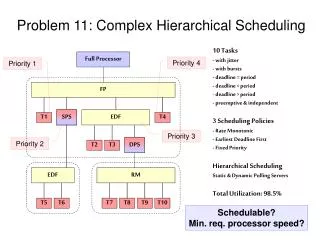
This study delves into complex hierarchical scheduling involving ten tasks with varying burst times and jitter. It discusses three primary scheduling policies: Rate Monotonic, Earliest Deadline First, and Fixed Priority. The framework considers preemptive and independent tasks with deadlines equal to, less than, and greater than their periods, ensuring a total utilization of 98.5%. The paper also examines the periodic server model, where tasks serve as polling servers, checking resources and managing workloads preemptively. A thorough analysis determines the minimum required processor speed for schedulability.

Comprehensive Analysis of Complex Hierarchical Scheduling for Real-Time Systems
E N D
Presentation Transcript
Problem 11: Complex Hierarchical Scheduling • 10 Tasks • - with jitter • - with bursts • - deadline = period • - deadline < period • deadline > period • preemptive & independent • 3 Scheduling Policies • - Rate Monotonic • - Earliest Deadline First • - Fixed Priority • Hierarchical Scheduling • Static & Dynamic Polling Servers • Total Utilization: 98.5% Full Processor Priority 4 Priority 1 FP SPS EDF T1 T4 Priority 3 DPS Priority 2 T2 T3 EDF RM T5 T6 T7 T8 T9 T10 Schedulable? Min. req. processor speed?
Real-Time Load Specification pSPS = 4 (period) pDPS = 3 (period) eSPS = 1 (execution share) eDPS =1 (execution share) dSPS = 4 (deadline) dDPS = 3 (deadline)
Periodic Server • A polling server can be thought of as a periodic task T (p, e). • When the server-task T is selected to run by the scheduler, the server-task checks whether workload is waiting to be processed by the server. • If yes, the server will provide e resources to process the waiting workload. • If no work is available for the server, the task will immediately be finished, i.e. the server will not check for arriving work anymore until the next period starts. • While the server is processing, it is preemptable. When it is preempted, it is put back into the ready-queue. • If the server could not provide e resources during a time interval T, even though there was always enough work available, then this is treated the same as a deadline-miss. I.e. the system is considered to be not schedulable.