Rheumatologic Conditions
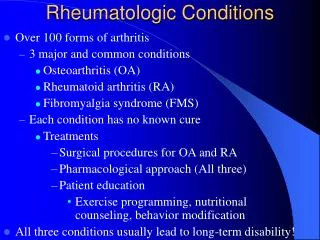
Rheumatologic Conditions. Over 100 forms of arthritis 3 major and common conditions Osteoarthritis (OA) Rheumatoid arthritis (RA) Fibromyalgia syndrome (FMS) Each condition has no known cure Treatments Surgical procedures for OA and RA Pharmacological approach (All three)

Rheumatologic Conditions
E N D
Presentation Transcript
Rheumatologic Conditions • Over 100 forms of arthritis • 3 major and common conditions • Osteoarthritis (OA) • Rheumatoid arthritis (RA) • Fibromyalgia syndrome (FMS) • Each condition has no known cure • Treatments • Surgical procedures for OA and RA • Pharmacological approach (All three) • Patient education • Exercise programming, nutritional counseling, behavior modification • All three conditions usually lead to long-term disability!
Osteoarthritis • Degenerative joint disease or osteoarthrosis • Most common form of arthritis • One of the most common chronic diseases in the US • 40 million Americans • 2nd most common cause of long-term disability in the adult pop. • This is not a normal characteristic of aging as many claim it to be!
Epidemiology & Pathophysiology • Characterized by: • Localized degeneration of the articular cartilage • This is the major pathology! • Synthesis of new bone at the joint surfaces/margins • Typically effects: • Hips • Knees • Feet • Spine • Hands
Primary Risk Factors • Age • Gender • Race • Occupation (related to chronic overuse) • Obesity • History of joint trauma • Bone or joint disorders • Genetic mutations of collagen • History of inflammatory arthritis
Who Does OA Affect? • Symptoms are not always present in OA • 90% of population show degenerative effects in weight bearing joints (hips, knees, feet) by age 40! • After age 50, its more prevalent in women than men • Associated in severity & the # of joints affected • Hip, knee, and hand in women • Older men more susceptible to hip OA • Knee OA is more prevalent in AA women than: • Caucasian females • Obese females • Non-smokers • Physically active females
Two Major Types of OA • Primary or Idiopathic • Most common type • Diagnosed when there is no known cause for the symptoms • Secondary • Diagnosed when there is an identifiable cause • Trauma or Underlying joint disorder • Each of these major types has subtypes
Common Major Criterion for OA • Presence of pain • No nerve supply to the articular cartilage • Pain may be associated with the following: • Inflammation of the synovium • Medullary hypertension • Microfractures in the subchondral bone • Stretching of periostal nerve endings by osteophytes (spurs) • Stretching of ligaments • Spasming of muscles around the inflamed joint capsule
Common Symptoms & Features of OA • Localized pain and stiffness in and around the joint • Osteophytes (bony hypertrophy/spurs) • Cartilage destruction • Joint malalignment • Movement/gait problems • Muscle weakness • Activity limitations • Morning stiffness lasting less than 30 minutes • Pain is worse with activity and better with rest
Specific Joint Symptoms • Knee OA • Instability and buckling of the knees • Hip OA • Groin pain and radiating leg pain • Hand OA • Decreased manual hand dexterity • Neck and Low Back OA • Radiating pain, weakness, and numbness (nerve root compression)
Common Outcomes • As pain upon joint loading and weight bearing, physical activity and joint mobility decrease! • Joint contractures especially in the weight bearing joints • Decrease in joint mobility decreases effectiveness of movements • Increase risk of comorbidities due to a lack of activity • Heart disease • Hypertension • Obesity • Diabetes • Depression • Some Cancers
Exercise Testing Considerations • Tests should be done in the most pain-free manner • Address patient positioning and biomechanics of tests • Testing sequence • Adequate recovery between different testing components • Does the risk of testing outweigh the benefits? • If it does, don’t test them!!
Testing Components • Assessment of pain (qualitative/quantitative) • Arthritis Impact Measurement Scales 2 • WOMAC Osteoarthritis Index • Physical limitations assessment • Physical function assessment • 6 minute walk plus HR response and RPE • Rising from a chair for 1 minute • Flexibility • Sit and Reach, Individual joint ROM • Muscle function • Isometric,istonic, or isokinetic • Cardiovascular function • Submaximal test (Cycle may be better than treadmill)
Exercise Prescription & Programming • Address characteristic symptoms and limitations • Focus on functional capability to start • Flexibility is vital due to their restricted ROM • Increase muscular endurance first then strength • Select non-weight bearing resistance training first • Progress to aerobic activities • Minimize pain associated with impact • Add in alternatives to enhance compliance • Kinesthetic awareness and balance • Yoga, Tai Chi, etc. • Table 10.1
Flexibility Guidelines • Pain-free ROM • 3-5 times per day • 10-15 minutes per session • Dynamic ROM instead of a passive ROM • Very low intensity • Gentle movements • Modified Yoga would be great!
Resistance Training • Isometric training • Pain-free due to lack of movement • Increase muscular strength through maximal voluntary isometric contractions • 3-5 maximal contractions per muscle group once a day • Hold each contraction for 5-10 seconds • 2-3 sessions per week • Start at 10% of maximal values • Progress no more than 10% per week • Start with slow controlled movement velocity • Focus on excellent technique • Gradually increase speed of movement in order to recruit all fiber types
Resistance Training • Isotonic and/or isokinetic • Pain-free due to lack of movement • Focus on excellent technique • 2-3 sessions per week • Start with slow controlled movement velocity but progress to moderate velocity as quickly as possible
Cardiovascular function • Low impact options • Swimming, etc. • Accumulate 30-60 minutes per day • 3-4 sessions per week • 60-80% of peak HR or 50-70% of HRR or VO2res • Progress slowly with intensity • Be aggressive with duration!
DLA/ADL Routine • Design home routine for the individual • Perform daily • Provide specific progressions • Individual should keep diary of ADL activities and how they feel they are progressing!