Download
1 / 15
160 likes | 283 Vues
This educational overview by Dr. Carrie A. Thomas, PhD, provides essential insights for public health professionals investigating febrile rash illnesses. It covers critical assessment features including rash distribution, progression, color, and texture, alongside accompanying signs and symptoms, such as fever and respiratory issues. Common medical terms related to rash diagnoses are defined, enhancing understanding for better patient management. Case studies and practical guidelines are presented to assist epidemiologists in effectively responding to outbreaks.

E N D
Assessing Rash Characteristics Carrie A. Thomas, PhD Epidemiologist (VPD/IBD) Division of Infectious Disease Epidemiology West Virginia Bureau for Public Health www.wvidep.org (304) 558-5358
Objectives • Describe features you should assess when investigating a report of a febrile rash illness • Review accompanying signs and symptoms associated with febrile rash illnesses • Define commonly used medical terms related to febrile rash illnesses
Distribution • Where is the rash located? • Localized – restricted to one area of the body • Generalized – present on several areas of the body
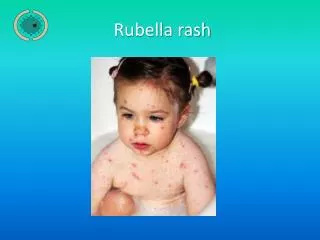
Distribution • Where is the rash located? • Localized – restricted to one area of the body • Generalized – present on several areas of the body Localized rash – Lyme Disease Generalized rash – Rubella
Progression • Did the rash move over the body during the course of illness? Smallpox on first day of skin rash onset
Color • What color is the rash? • Rashes can appear red, white, purple or silver • Is the color uniform or patchy/blotchy?
Color • What color is the rash? • Rashes can appear red, white, purple or silver • Is the color uniform or patchy/blotchy? Meningococcemia Measles
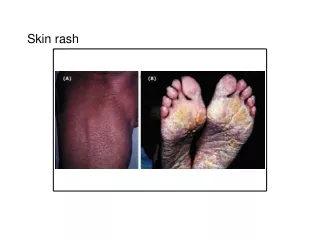
Texture • Rashes can be flaky, scaly, bumpy or smooth and the texture of the bumps may range from fine to course and can be solid or fluid-filled Scarlet fever Chickenpox
Additional details • Record additional details about the rash • Is it itchy? • Is it sore? • Is it numb or tingly? • Is it scabbing or crusty? • If there’s fluid involved, what color?
Accompanying signs and symptoms • Ask about additional signs/symptoms (and their timing in relation to rash onset date) • Fever, highest recorded temperature • Cough • Conjunctivitis • Respiratory symptoms, including runny nose • Joint pain • Swollen lymph nodes • Fatigue
Case Study • Get a report from a school that they have an outbreak of a rash illness • What’s the first thing you want to know?
Case Study • Get a report from a school that they have an outbreak of a rash illness • What’s the first thing you want to know? Fifth Disease aka Parvovirus B19
Medical Terms • Papule - A small solid rounded bump rising from the skin (scarlet fever) • Vesicle - a small blister filled with fluid (Hand, Foot & Mouth Disease) • Macule - A small localized change in the color of skin that is neither raised (elevated) nor depressed (Rocky Mountain Spotted fever) • Pruritic – itchy • Erythematous – red • Petechiae - Pinpoint flat round red spots under the skin surface caused bleeding into the skin (do not turn pale with pressure) • Purpura - A hemorrhagic area in the skin. Early purpura is red and becomes darker, then purple, and brown-yellow as it fades. Does not blanch when touched.
Summary • Distribution / Location • Progression • Color • Texture • Additional info about the rash presentation • Itchy, sore, numb, etc. • Accompanying signs and symptoms • Fever, cough, respiratory symptoms, etc.