The BEDMAP Project: Reusing Data to Make Predictions
Discover how the BEDMAP Project utilized shared data to predict Antarctica's ice thickness and potential sea level rise, succeeding through international cooperation and strategic data management.

The BEDMAP Project: Reusing Data to Make Predictions
E N D
Presentation Transcript
The BEDMAP Project An example of re-using shared data to make globally relevant predictions
Antarctica. • The questions addressed. • The process undertaken. • The products. • Why the project succeeded. • And thus what lessons can be learnt.
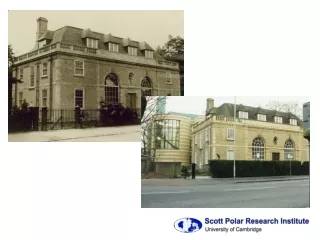
Antarctica • 13M km2. Over 58 times the size of the UK, the highest, coldest and windiest continent. • Icecap contains almost 70% of the world's freshwater and 90% of the world's ice. • British Antarctic Survey. A wholly owned NERC Research Centre. • Undertakes the majority of Britain's scientific research on and around the Antarctic continent.
Questions • What is the shape of the land beneath the ice sheet? • How much ice is there in the ice sheet? • And thus its potential contribution to sea level rise.
Process • BEDMAP consortium: 12 countries under the auspices of SCAR. • Protocol: data remain under ‘control’ of contributors so some access restrictions. • Production of database of ice thickness measurements. • 2.5M direct measurements; • Estimate 90% of all data existing (2000); • 10% not included: old data now lost & recent surveys not released by PIs.
Product • Ice thickness model(5km grid)
Product • Sub-ice topography
Product • Sub-ice topography
Product • Coordinated database and gridded data sets
Product • New estimate for volume of Antarctic ice sheet: 25.4 x 10⁶ km3. • Close to early estimates, but 15% less than widely quoted 30.1 x 10⁶ km3 from 1983. • New estimate for amount of sea level equivalent of the ice volume: 57m. • Lower than other estimates: 73m (1986) and 61m (2000).
Success • Antarctic Treaty, Article III-1-c. • scientific observations and results from Antarctica shall be exchanged and made freely available. • Antarctic science is international – expectation of cooperation. • A project of the scientific community.
Success • Data were known: information available on what data exists and the specifics of the data. • Metadata not always formally documented, PIs had their own detailed knowledge. • Funds available to do the work. • Defined goal to the project. • Good staff: Understood the science and the data issues.
Further information • NERC: www.nerc.ac.uk • BAS: www.antarctica.ac.uk • BEDMAP: www.antarctica.ac.uk/aedc/bedmap • SCAR: www.scar.org • Reference: Lythe, M.B. & Vaughan, D.G. BEDMAP: A new ice thickness and subglacial topographic model of Antarctica. J. Geophys. Res., 106 B6, 11,335 – 11,351, 2001.