Alkynes
This article explores alkynes, a class of hydrocarbons featuring a triple bond between carbon atoms. With the general formula CnH2n-2, alkynes include ethyne and propyne. We dive into IUPAC nomenclature rules for naming alkynes, emphasizing the importance of the longest carbon chain and point of triple bonds. The physical properties such as gas, liquid, and solid states are also discussed, along with their solubility and boiling points. Alkynes play vital roles in energy sources and industry, serving as precursors for plastics, textiles, and other materials.


Alkynes
E N D
Presentation Transcript
Alkynes (Session 32) Ciencias de la tierra II
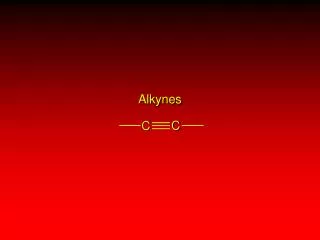
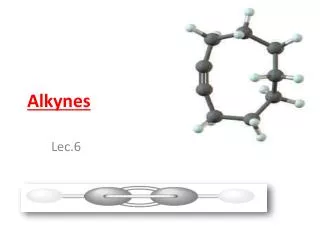
Alkynes • Hydrocarbons in which two carbon atoms share three pair of electrons within themselves, and for this reason, they are bonded by triple links . General Formula CnH 2n -2 • The two elemental Alkynes are ethyne and propyne H-C≡C-H CH3-C ≡ C-H Ethyne or Propyne Acetylene Ciencias de la tierra II
Nomenclature • Basic IUPAC rules are applied. • The ending (suffix) for Alkynes is “yne”. • The longest C chain is picked that has triple links to give the name base of the alkyne. • The longest carbon chain is numbered in the extreme where the triple link is closest. The lowest carbon is put prior to the name to indicate its position in the chain. For example 3 octyne. • If it is branched we write first before the name the position and name of the ramifications. Ciencias de la tierra II
Physical Properties • The first the 3 Alkynes are gases at room temperature, the ones that have from 5 to 15 C atoms are liquids and the one with 16 or more are solids. • The boiling points increase when the molecular weight is increased. • Linear Alkynes have higher boiling points then the branched with similar molecular weight. • Alkynes are insoluble in water, but they are soluble in other non polar solvents like ethers, hexane, tetrachloride of carbon, etc. • Alkynes are less dense then water for this reason they float in it. Ciencias de la tierra II
Physical Properties acetylene • In a colorless gas, with a ethereal agreeable scent. • They are easily blended (its critical temperature is 36 °C). • Blending at pressure, with out precaution can be dangerous; the liquid, unstable, and highly explosive. • Is not very soluble in water and it highly soluble in acetone and other non polar organic solvents. Ciencias de la tierra II
Preparation of acetylene in the lab from the calcium carbon: CaC2 + 2H2O C2H2 + Ca(OH)2 Calcium Carbon Preparation in the industry from methane: 2 CH4 C2H2 + 3 H2 - 96 kcal Ciencias de la tierra II
Chemical Properties of Alkynes • Combustion (Oxidation) • Reactions by Addition • Hydrogenation • Halogenations Ciencias de la tierra II
Applications and Importance of Alkynes • Sources of Energy (gases) • Primary material for the formation of a large quantity of polymers and plastics ethyne and propyne) • The most important acetylene applications of Alkynes: • Lighting, oxyacetylene blowpipe, black of acetylene, raw material for the ethylene production, acetaldehyde, acid acetic, drying acetone, cumin, benzene, oils, synthetic rubbers, plastics, textiles, nylon, etc. Ciencias de la tierra II
Bibliography • Bloomfield, M. (1997) Chemistry in Living Organisms. 1st ed. Mexico: LIMUSA • Rakoff, H. et al. (1992) Fundamental Organic Chemistry. 1st ed. Mexico: LIMUSA • Solomons, G. (1996) Fundaments of Organic Chemistry. 2nd. ed. Mexico: LIMUSA Ciencias de la tierra II