Principles of Population Ecology: Understanding Population Dynamics and Human Growth
This chapter delves into the fundamental principles of population ecology, exploring critical questions such as the size, growth trends, reproductive and mortality patterns of populations. It illustrates how population density impacts ecological dynamics and examines the factors affecting population change on both global and local scales, including birth rates, death rates, immigration, and emigration. Furthermore, it contrasts different reproductive strategies and the implications of environmental resistance. Special attention is given to the human population's rapid growth, demographic trends, and future projections.

Principles of Population Ecology: Understanding Population Dynamics and Human Growth
E N D
Presentation Transcript
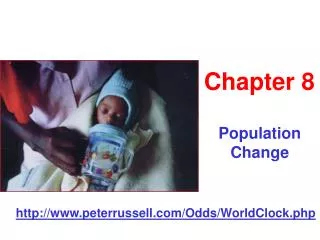
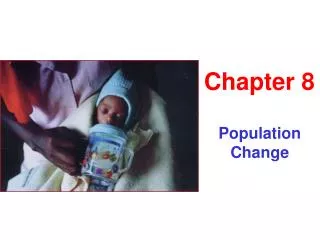
Chapter 8 Population Change
Principles of Population Ecology • Population ecologists ask: • 1) How many are in the population? • 2) Are its numbers increasing / decreasing? • 3) What is its pattern of reproduction? • 4) What is its pattern of mortality?
Principles of Population Ecology 20 / 25 m2 20 / 100 m2 • Population Density: • Not enough to know just how many. • Need to know per unit area.
Principles of Population Ecology • How Do Populations Change in Size? • On a global scale (closed system):
Principles of Population Ecology • How Do Populations Change in Size? • On a local scale (open system):
Principles of Population Ecology Death rate Growth rate Birth rate • How Do Populations Change in Size? • Global scale: r = b – d
Principles of Population Ecology Death rate Growth rate Emigration rate Birth rate Immigration rate • How Do Populations Change in Size? • Local scale: r = (b – d) + (i – e)
Principles of Population Ecology • Maximum Population Growth- • under ideal conditions = intrinsic rate of increase J-shaped curve (exponential growth)
Principles of Population Ecology • Environmental Resistance- • Exponential growth cannot occur forever. • What factors prevent it from doing so? S-shaped curve (logistic growth)
Principles of Population Ecology • Overshooting the carrying capacity can lead to a population crash.
Reproductive Strategies K-selected vs. high growth rate slow growth rate small body size large body size early maturity late maturity short life span long life span large broods small broods little / no parental care high parental care • Life History Strategies r-selected
Reproductive Strategies • Survivorship
Factors that Affect Population Size • Density-Dependent Factors- • Factors that influence population growth when its density is high. • Predation, competition, disease.
Factors that Affect Population Size • Density-Dependence and Boom-or-Bust Population Cycles
Factors that Affect Population Size • Case-in-Point: Predatory Prey Dynamics on Isle Royale
Factors that Affect Population Size • Density-Independent Factors- • Regardless of population density, influences population growth. • Weather, fire.
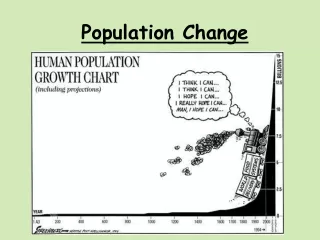
The Human Population • Human population size
The Human Population • Current Population Numbers • In 2004 = ~6.4 billion • Check out: • http://www.census.gov/main/www/popclock.html
The Human Population • Current Population Numbers • Rapid growth primarily due to drop in death rates
The Human Population • Projecting Future Population Numbers • When will zero population growth occur?
Demographics of Countries • Most Populous Countries
Demographics of Countries • Developed vs. Developing Countries Demographics
Demographics of Countries • Developed vs. Developing Countries Demographics
Demographics of Countries • Demographic Stages
Demographics of Countries • Age Structure of Countries • Generalized Age Structure
Demographics of Countries • Examples:
Demographics of Countries • Examples:
Demographics of Countries • Examples:
Demographics of Countries • Population Under Age 15:
Demographics of the US • Case-in-Point: US Immigration