Various Sectors of Development
100 likes | 236 Vues
This article explores various sectors of development, focusing on the community economy, education, and social aspects. It discusses productivity changes in a country as measured by indicators like Gross National Product (GNP), income per capita, and economic growth. Additionally, it examines social development indicators such as literacy rates and quality of life, the significance of infrastructural development for economic stability, and the role of industrial and agricultural advancements in driving economic growth. Through a holistic approach, the article emphasizes the interconnectedness of these sectors for sustainable development.


Various Sectors of Development
E N D
Presentation Transcript
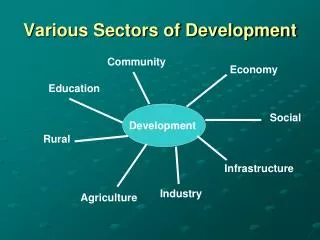
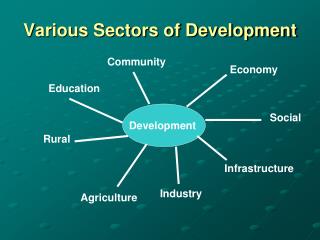
Various Sectors of Development Community Economy Education Development Social Rural Infrastructure Industry Agriculture
Economic Development • Changes in a country that involve increase in productivity • Productivity is measured in various ways, e.g.: GNP - Gross National Product - Total cumulative production in a year that consists of incomes or revenues from the various sectors.
Other economic indicators: • Income Per Capita • Economic Growth or % of GNP • Number of SMIs, large industries, or MNCs. • Economic development is always equated with quantitative increase of assets.
Social Development • Changes in a population that involves improvement in Quality of Life. • Indicators: • Better education • % of population with tertiary education • Rate of literacy • Better health • Life expectancy • Infant Mortality Rate • Toddler Mortality Rate
Social integration • Ethnic, religion, culture • Urban and rural areas • West and East Malaysia • Sound social development is important for economic stability.
Infrastructural Development • Changes in physical amenities such as transportation system (highways), electricity and water supplies, and other public facilities such as buildings for commerce, administration, and public services. • Infrastructural development is positively related to changes in economic and social development.
Industrial Development • Involves changes in the various types of industries such as manufacturing, electrical and electronic (EE), SMIs, high-technology industries, downstream industries and agro-based industries • Important for employment and for contribution to GNP. • For domestic and export.
Agricultural Development • Involves changes in the production of agricultural commodities such palm-oil, paddy, livestock, forestry, fruits and vegetables. • Changes are accompanied by the use of agricultural technologies such as improved high-yielding varieties, fertilizers, pesticides, agricultural management and drainage system. • Agricultural production contributes to economic development.
Rural Development • Comprises agricultural development and the development of the population in the rural areas. • Broader concept that also involves development in health, infrastructure and social.
REFERENCE Look for relevant articles at COMMUNITY DEVELOPMENT JOURNAL http://www.oxfordjournals.org/our_journals/cdj/about.html