Allen Bradley 1756-L75
0 likes | 1 Vues
ROC Automation offers the Allen Bradley 1756 L75, a high-performance ControlLogix 32 MB controller ideal for demanding industrial automation and motion control systems. This processor supports extensive I/O, built-in USB programming, and advanced diagnostics for reliable plant-wide control applications. Buy now on https://rocautomation.co/


Allen Bradley 1756-L75
E N D
Presentation Transcript
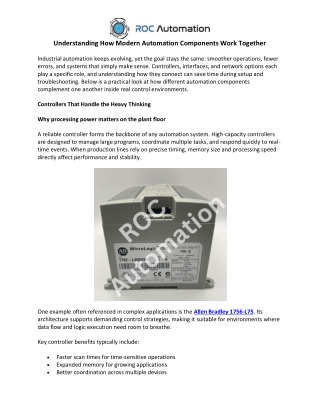
Understanding How Modern Automation Components Work Together Industrial automation keeps evolving, yet the goal stays the same: smoother operations, fewer errors, and systems that simply make sense. Controllers, interfaces, and network options each play a specific role, and understanding how they connect can save time during setup and troubleshooting. Below is a practical look at how different automation components complement one another inside real control environments. Controllers That Handle the Heavy Thinking Why processing power matters on the plant floor A reliable controller forms the backbone of any automation system. High-capacity controllers are designed to manage large programs, coordinate multiple tasks, and respond quickly to real- time events. When production lines rely on precise timing, memory size and processing speed directly affect performance and stability. One example often referenced in complex applications is the Allen Bradley 1756-L75. Its architecture supports demanding control strategies, making it suitable for environments where data flow and logic execution need room to breathe. Key controller benefits typically include: Faster scan times for time-sensitive operations Expanded memory for growing applications Better coordination across multiple devices
Compact Controllers for Smaller Systems When simplicity is the smarter option Not every system needs a large controller. Smaller machines, remote panels, and standalone processes benefit from compact designs that combine power and efficiency. These controllers reduce wiring complexity while still supporting essential I/O and communication needs. A common choice in this category is the 1762-L40BXBR. Integrated power and I/O make it a practical option for installations where space and cost control are priorities. Compact controllers are often chosen because they: Simplify panel layouts Reduce installation time Offer dependable performance for focused tasks Operator Interfaces That Improve Daily Workflow Clear visuals lead to better decisions An automation system is only as effective as its interface. Operators rely on screens to monitor status, acknowledge alarms, and adjust settings. A responsive, well-designed terminal helps reduce mistakes and shortens response times during critical moments. The 2711P-T7C21D8S Allen Bradley is often highlighted for its balance of screen clarity and functionality. Touch input and graphical displays make complex data easier to understand at a glance. Helpful interface features usually include: Intuitive navigation menus Clear alarm notifications Real-time system feedback Networking Options That Keep Everything Talking Communication is the hidden backbone Even the best hardware struggles without solid communication. Network modules allow devices to exchange data efficiently, supporting diagnostics, remote monitoring, and coordinated control. Dual-port options add flexibility, especially when systems expand or need redundancy.
The 20-750-ENETR represents how modern networking components simplify integration across drives and controllers. Strong networking solutions help by: Improving system visibility Reducing downtime through diagnostics Supporting scalable architectures Bringing the Pieces Together Automation works best when each component plays its role without friction. High-capacity controllers manage logic, compact units handle localized tasks, operator interfaces translate data into action, and network options keep everything connected. Understanding how these pieces interact creates systems that are easier to maintain and ready for future growth. When Technology Starts Working With You The real win in automation is reaching a point where systems feel predictable and supportive rather than complex. With the right mix of controllers, interfaces, and communication tools, daily operations become calmer, troubleshooting gets faster, and progress feels natural instead of forced.













![[Pdf] Stop Smoking Now](https://cdn5.slideserve.com/11137128/slide1-dt.jpg)