Download
1 / 22
230 likes | 399 Vues
This session explores the Cuban Missile Crisis through the lens of the Cold War, employing the ABC-CLIO inquiry method. Attendees will develop key questions surrounding this pivotal moment, analyzing the motives of key leaders like JFK and Khrushchev and understanding the ideological tensions that defined the era. We will investigate the realities of missile placements, the concept of brinkmanship, and the broader implications of the nuclear arms race. This concise, engaging discussion aims to enhance understanding of historical complexities in less than 50 minutes.

E N D
The Cuban Missile Crisis Graceful Generalizing, Cold War Strategy, and seeing all sides in less than 50 minutes. NCSS Conference
The ABC-CLIO Inquiry Method • Step 1: Develop Key Questions • Step 2: Need To Know • Step 3: Develop More Key Questions • Step 4: More Need To Know • Step 5: The Enduring Dilemma • Step 6: Investigate
Do you know what the bay of pigs is? • Yes • No
#1. Key Questions: Asking the questions that allow for broader analysis • What was the Cold War? • Who where the main opponents during the Cold War? • When and what was the Cuban Missile Crisis? • Who were the critical leaders? • What was the reality of MRBMs and IRBMs?
A war of Ideology and Unthinkable weapons: Political and Economic
What was the Cold War? • Who where the main opponents during the Cold War? • When and what was the Cuban Missile Crisis? • Who were the critical leaders? • What was the reality of MRBMs and IRBMs?
What was the Cold War? • Who where the main opponents during the Cold War? • When and what was the Cuban Missile Crisis? • Who were the critical leaders? • What was the reality of MRBMs and IRBMs?
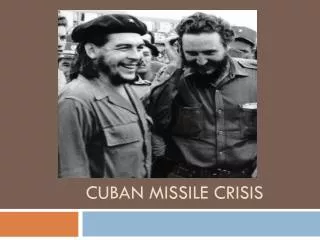
Birds of a Feather: F Castro and N Khruschev in ideological embrace.
The “Proof”: Clear evidence of a secrete build-up of missiles (MRBM and IRBM) in Cuba.
What was the Cold War? • Who where the main opponents during the Cold War? • When and what was the Cuban Missile Crisis? • Who were the critical leaders? • What was the reality of MRBMs and IRBMs?
3. More Need to Know: Second level of questions. • Why did the US react to the placement of Soviet missiles in Cuba when the US had placed its own Jupiter IRBMs in Turkey? • Why was it so critical for the US to go to the UN? • Why move to confrontation with the USSR/Cuba over the issue?
Why did the US react to the placement of Soviet missiles in Cuba when the US had placed its own Jupiter IRBMs in Turkey? • Why was it so critical for the US to go to the UN? • Why move to confrontation with the USSR/Cuba over the issue?
Evidence presented at the United Nations; support for a blockade.
Why did the US react to the placement of Soviet missiles in Cuba when the US had placed its own Jupiter IRBMs in Turkey? • Why was it so critical for the US to go to the UN? • Why move to confrontation with the USSR/Cuba over the issue?
Why did the US react to the placement of Soviet missiles in Cuba when the US had placed its own Jupiter IRBMs in Turkey? • Why was it so critical for the US to go to the UN? • Why move to confrontation with the USSR/Cuba over the issue?
US naval vessel and patrol craft intercept and ward off a Russian freighter.
5. The Enduring Dilemma: “What were the real motivations that lead Kennedy and Khruschev to act as they did?” • Nuclear Arms Race. • Ideological Conflict/Aspirations. • Third World Rivalries. • Relations with Allies (esp. USSR and Cuba). • Domestic Impact of Foreign Policy. • Personalities of the leaders.