Download
1 / 10
100 likes | 221 Vues
This presentation explores high resolution spectra of 11 blue compact dwarfs (BCDs) and 17 starbursts, obtained using the Spitzer Infrared Spectrograph (IRS). The study focuses on mid-infrared fine structure emission lines, particularly the [OIV] line which is prevalent in starbursts and indicative of massive star photoionization. The detection of [NeV] serves to highlight AGN presence. Results detail the high ionization lines’ origins, linking them to starburst activity, and discuss implications for understanding star formation and galaxy evolution.

E N D
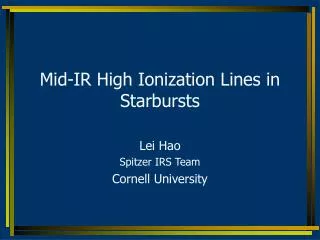
Mid-IR High Ionization Lines in Starbursts Lei Hao Spitzer IRS Team Cornell University
The Spitzer Telescope Infrared Spectrograph (IRS) • Low resolution modules (SL,LL) • 5-40m wavelength coverage • Resolution: 64-128 • High resolution modules (SH, LH) • 9-38m wavelength coverage • Resolution: 600 • Data • IRS of ~40 Nearby famous AGN and starbursts (Weedman et al. 2005, Brandl et al. 2005, in prep) • 62 BCDs/11 IRS spectra (Wu et al 2005, submitted) • This talk: high resolution spectra of 11 BCDs +17 Starbursts (no AGN components)
Mid-IR Fine Structure Emission lines • Less affected by extinction • Photoionized by massive stars • [OIV] in starbursts • Requires 54.24 eV, just above the HeII edge • Weaker than in AGNs, ULIRGs • Shocks, super-hot stars, weak AGN • [NeV] in starbursts • Not observed in pure starburst, an indication of AGN presence
Results • 11 BCDs + 17 Starbursts (no AGN component) • [OIV] is ubiquitous • 7/11 BCDs and 15/17 Starbursts
Results • [NeV] is positively detected in three objects • 1/11 BCDs and 2/17 Starbursts CG0752 NGC4194 NGC2623
Origin of the High Ionization Lines • Photoionization • Starburst99+Mappings
Origin of the High Ionization Lines • Shock? by Lisa Kewley