Download
1 / 10
100 likes | 225 Vues
This study, presented by Tor Raubenheimer and conducted by Juhao Wu, explores the optimal undulator length required for Terawatt Free Electron Laser (TW-FEL) operation at 8 keV, 13 keV, and 18 keV. Seed power dependence has been investigated with seed undulator lengths ranging from 9 to 11 undulators (39 to 48 meters). Initial simulations focused on optimizing undulator lengths of 150, 200, and 250 meters. Results indicate the importance of seed power and undulator configuration on FEL performance, with a significant focus on optimizing the undulator design for LCLS-II.

E N D
Undulator length for TW FEL Studies performed by Juhao Wu Presented by Tor Raubenheimer
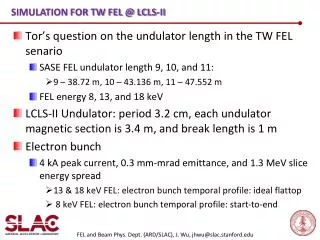
Initial Simulations for a TW FEL Study what undulator length is necessary for TW-FEL operating at: 8 keV, 13 keV and 18 keV Studied seed power dependance in the past 1 ~ 5 MW Varied the seed undulator length from 9 to 11 undulators (39 ~ 48 meters) Monochromator is modeled as a filter (typically 0.1% eff.) Optimized TW taper for 3 different lengths (150, 200, and 250 meters) Results from 15 seeds for 200 m optimization. Other results were done for comparison – results similar
simulation for TW FEL @ LCLS-II Summary: optimize for 200 m long second undulator
simulation for TW FEL @ LCLS-II Summary: optimize for 150 m long second undulator
simulation for TW FEL @ LCLS-II Summary: optimize for 250 m long second undulator
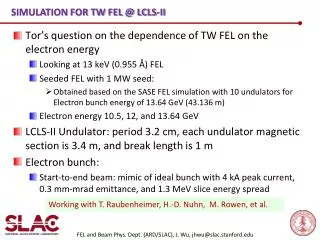
simulation for TW FEL @ LCLS-II Seed Seeded TW: Taper profile for 1 MW seed 13 keV FEL through a 1.2E-05 (FWHM) bandwidth The FEL centered @ 0.9547 Å
Summary Table Explore power as a function of fixed undulator length versus beam energy Optimize undulator period
Outstanding Issues • Existing (308 meter) undulator hall design can fit 188 meters of undulator with present mirror arrangement • May be able to gain some additional space • Electron bunch: 4 kA, 0.3 mm, and 1.3 MeV slice DE/E • Simulations do not include contingency (typically 20%) • Further optimization of simulations may improve results, e.g. optimization of beta functions for 18 keV yielded 50% improvement but this was not performed at 8 or 13 keV • Comparison with results from HXRSS not great • Presumably further optimization of experiment will improve those results