Artificial Intelligence ( AI )
This overview of Artificial Intelligence (AI) focuses on its definitions, goals, and historical milestones. AI is the study of creating intelligent machines capable of tasks traditionally better performed by humans, such as reasoning, learning, and adapting. Key events in AI history include landmark matches in computer chess, such as Kasparov vs. Deep Blue, and the development of early robotic systems like the Hopkins Beast and Stanford Cart. Through examining these aspects, we gain insight into the ongoing evolution and potential of AI technologies.

Artificial Intelligence ( AI )
E N D
Presentation Transcript
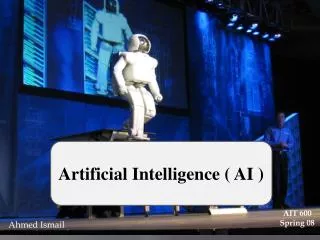
Artificial Intelligence ( AI ) AIT 600 Spring 08 Ahmed Ismail
What is the Artificial Intelligence? A.I. is the study of how to make computers do things at which, at the moment, people are better. AI is both the intelligence of machines and the branch of computer science which aims to create it.
Actuator Sensor
What’s involved in Intelligence? • Ability to interact with the world (speech, vision, motion, manipulation) • Ability to model the world and to reason about it • Ability to learn and to adapt
AI Goals • To build systems that exhibit intelligent behavior • To understand intelligence in order to model it
Computer Chess • 2/96: Kasparov vs Deep Blue • Kasparov victorious: 3 wins, 2 draws, 1 loss • 3/97: Kasparov vs Deeper Blue • First match won against world champion • 512 processors: 200 million chess positions per second
Researcher tries to maximize the performance of the agents. • Just do it. • Computer scientists approach • Researcher tries to understand how the agents produce responses • Wait, let me figure what’s going on first • Psychologists approach
Computer Chess • 2/96: Kasparov vs Deep Blue • Kasparov victorious: 3 wins, 2 draws, 1 loss • 3/97: Kasparov vs Deeper Blue • First match won against world champion • 512 processors: 200 million chess positions per second
Robotics – Hopkins Beast 1964 Two versions of the Hopkins beast, which used sonar to guide it in the halls. Its goal was to find power outlets. http://www.frc.ri.cmu.edu/~hpm/book97/index.html
Robotics – Stanford cart • 1971- Stanford cart. Remote controlled by person or computer. • 1971- follow the white line • 1975- drive in a straight line by tracking skyline • 1979- get through obstacle courses. Cross 30 meters in five hours, getting lost one time out of four http://www.frc.ri.cmu.edu/~hpm/book97/ch2/index.html
Phil, the drug robot, introduced in 2003 Moving Around and Picking Things Up
Robot Evolution http://cosmos.bcst.yahoo.com/up/player/popup/index.php?cl=7318200
Questions? http://www.ai.mit.edu/projects/humanoid-robotics-group/kismet/kismet.html