The Russian Revolutions: From Autocracy to the Bolshevik Rule
The tumultuous period of revolutions in Russia marks a dramatic shift from autocratic rule to the establishment of the first Communist government. Long-standing social unrest, exacerbated by rapid industrialization and inequality, ignited revolutionary fervor. Key events include the 1905 Bloody Sunday and the March Revolution of 1917, which forced Czar Nicholas II to abdicate. The Bolshevik Revolution followed in November 1917, led by Lenin, promising "Peace, Land, and Bread!" and resulting in a civil war, establishing the USSR and uniting socialist republics under a central government.

The Russian Revolutions: From Autocracy to the Bolshevik Rule
E N D
Presentation Transcript
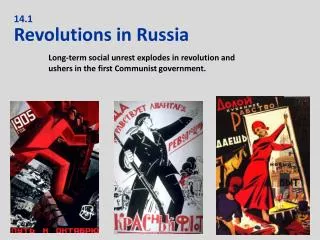
14.1 Revolutions in Russia Long-term social unrest explodes in revolution and ushers in the first Communist government. NEXT
Czars Resist Change • Alexander III and Nicholas II • 1881: Alexander III czar • “Autocracy, orthodoxy, and nationality” • Censorship, secret police, exile • Oppressed non-Russians • pogroms—organized violence against Jews • Nicholas II continues autocracy NEXT
Industrialization • 1863-1900: factories double; Russia still behind • 1890s: Witte industrializes Russia • steel production • Trans-Siberian Railroad • The Revolutionary Movement Grows • Unrest—gap between rich and poor increases • Marxism popular: rule of the proletariat • MENSHEVIKS • Want broad, popular support • BOLSHEVIKS • favor revolution by a small committed group • Lenin—Bolshevik leader NEXT
Crises at Home and Abroad Factors of civil unrest: • defeat in Russo-Japanese War • Bloody Sunday: The Revolution of 1905 • Massacre of 200,000 workers marching on Winter Palace for reform • Nicholas forced to reform: • 1906: The Duma—first parliament • refuses to share power; dissolves Duma in 10 weeks • World War I • Unprepared and ineffective—major losses • Czarina Alexandra runs government • influenced by Rasputin—mysterious “holy man” • corrupt; murdered by nobles
The March Revolution March 1917: strikes expand; soldiers refuse to fire on workers • The Czar Steps Down • Protests becomes uprising; Nicholas abdicates • Dumaestablishes provisional government • Soviets—committees of Socialist revolutionaries—control cities • Lenin Returns to Russia • April 1917: Germans aid Lenin in returning from exile to Russia • Germany hopes to hurt war effort NEXT
The Bolshevik Revolution • “Peace, Land, and Bread!” • November 1917: workers take control of the government • Bolsheviks and Lenin: • Give land to peasants • put workers in control of factories • Signs treaty with Germany to exit WWI • Civil War in Russia • Red Army wins three-year war; 14 million dead RED ARMY Bolsheviks; led by Leon Trotsky WHITE ARMY Opposed Bolsheviks; aid from U.S.
Lenin Restores Order • New Economic Policy • March 1921: launches NEP—small-scale capitalism • 1928: Russia’s farms, factories are productive again • Political Reforms • creates self-governing republics under central government • 1922: Union of Soviet Socialist Republics(U.S.S.R.) • Renames Communist Party • Power struggle to replace Lenin: Trotsky vs. Stalin • Joseph Stalin—Communist Party general secretary • 1924: Lenin dies • 1928: Stalin gains complete control; exiles Trotsky NEXT