Periodic Trends
70 likes | 175 Vues
This overview discusses the periodic trends affecting the reactivity of active metals, focusing on key concepts such as ionization energy, electron affinity, electronegativity, and atomic radius. It explains how reactivity increases down a group due to decreasing ionization energy, while ionization energy itself increases across a period. Additionally, it covers how electron affinity and electronegativity relate to an atom's ability to attract electrons and how atomic radius trends vary. Understanding these concepts is essential for grasping the behavior of active metals in chemical reactions.


Periodic Trends
E N D
Presentation Transcript
Reactivity of Active Metals • Active metals become more reactive as you go down a group
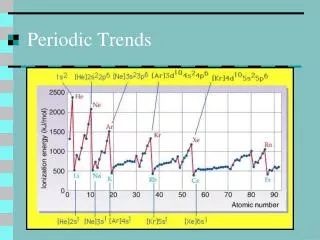
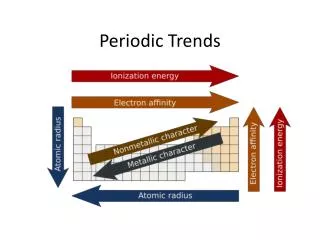
Ionization Energy • Energy required to remove the most loosely held electron from an atom • The greater the ionization energy, the more strongly the atom holds onto its electrons • M + energy → M+ + e • Ionization energy increases as moving across a period • Ionization energy decreases as moving down a group
Electron Affinity • Energy released when an atom gains an electron • Energy released is always shown with a negative number • Increases as you move across a period • Decreases as you move down a group
Electronegativity • Measure of the ability of an atom to attract electrons • Ranges from .7 to 4.0 • If they have a high electronegativity, they have a strong desire for electrons • Increases across a period • Decreases down a group
Atomic Radius • Half of the distance between two adjacent nuclei • Radius decreases across a period (atoms hold the electrons tightly in) • Radius increases down a group