Understanding Dipole and Multipole Expansion in Electric Potential at Large Distances
110 likes | 518 Vues
This article explores the concept of the dipole and multipole expansion for electric potential, particularly in the context of charge distributions at large distances. It highlights the importance of spherical harmonics and solutions for 3D separation as well as the angular distribution of electric fields. The addition theorem for Legendre polynomials and the significance of monopole and dipole terms are discussed, alongside the nature of electric field vectors. Key benefits and considerations for coordinate system dependence in multipole moments are also examined.


Understanding Dipole and Multipole Expansion in Electric Potential at Large Distances
E N D
Presentation Transcript
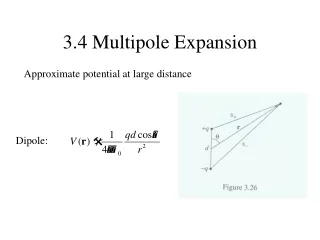
Dipole: 3.4 Multipole Expansion Approximate potential at large distance
Potential of a general charge distribution at large distance Warning! The integral depends on the direction of r.
Spherical harmonics: solutions for 3D separation Angular distribution at large distance Addition theorem for Legendre polynomials:
monopole dipole dipole moment The monopole and Dipole Terms
physical dipole “pure” dipole is the limit Dipole moments are vectors and add accordingly. A quadrupole has no dipole moment.
In general, multipole moments depend on the choice of the coordinate system. Has a dipole moment. If Q=0 the dipole moment does not depend on the coordinate system.