Understanding Elastic and Inelastic Collisions: Kinetic Energy Insights
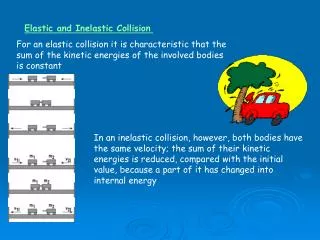
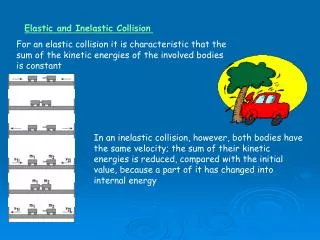
Collisions can be categorized as elastic or inelastic based on kinetic energy conservation. To determine the type of collision, one must calculate the total kinetic energy before and after the event. While energy is conserved in all collisions, inelastic collisions convert kinetic energy into other forms, such as heat or sound. This understanding is crucial in physics as it helps predict the outcomes of collisions in various scenarios, such as car crashes or particle interactions.


Understanding Elastic and Inelastic Collisions: Kinetic Energy Insights
E N D
Presentation Transcript
Elastic and Inelastic collisions The truth about …
The only way to tell … … whether a collision is elastic or inelastic is to find out whether kinetic energy is conserved or not. You have to calculate the kinetic energy before and after the collision. Note that energy is always conserved but kinetic energy is turned into heat and/or sound in an inelastic collision.