Understanding Federalism: Authority and Structure of Government Levels
130 likes | 245 Vues
Federalism is a system of governance where two or more levels of government have authority over the same area and people. In the U.S., the national government handles economic and military matters, while state governments focus on safety, health, and morals. The Constitution defines powers: national powers are enumerated, while reserved powers belong to the states. Federalism promotes decentralization, local diversity, and serves as laboratories for democracy. However, it can also lead to confusion and power struggles, clarified by the Supremacy Clause and the 10th Amendment.


Understanding Federalism: Authority and Structure of Government Levels
E N D
Presentation Transcript
Definition Two or more levels of government that have authority over the same area and people.
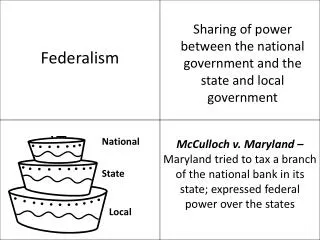
Both national and state governments have areas that they specialize in: • National: Economic & Military • State: Safety, Health, & Morals
Congress is given its power by enumerated powers clearly listed in the Constitution. • States are given all other powers, known as reserved powers.
Both National and State were empowered by the Constitution & both are a part of amending the Constitution.
What are the benefits of Federalism? • It decentralizes government and creates a further safeguard of liberties • Protects local diversity • Allows for laboratories of democracy
What are the drawbacks of Federalism? • Confusion • Power struggles
Whose power is supreme? The answer is covered in Article VI, known as the Supremacy Clause. Power goes in this order: • The Constitution • Laws of the national government • Treaties • State laws
However, the national government can only make laws within its own sphere of enumerated powers. It can't take away law-making power from the states. *The 10th amendment clears this up by saying that any power not given to the national government are reserved for the states.