
Comparison of Feature Sets and Classifiers in Electromyogram Signal Classification
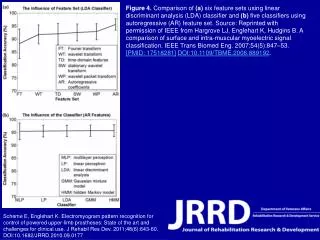
This study compares six feature sets using Linear Discriminant Analysis (LDA) and evaluates five classifiers utilizing autoregressive (AR) feature sets for electromyogram (EMG) signal classification. The aim is to determine the effectiveness of different features and classification methods in accurately interpreting EMG signals for applications such as powered upper-limb prostheses control. By analyzing the performance of these combinations, insights into their relative strengths and challenges for clinical use are provided, paving the way for advancements in prosthetic technology.

Comparison of Feature Sets and Classifiers in Electromyogram Signal Classification
E N D
Presentation Transcript
Figure 4. Comparison of (a) six feature sets using linear discriminant analysis (LDA) classifier and (b) five classifiers using autoregressive (AR) feature set. Source: Reprinted with permission of IEEE from Hargrove LJ, Englehart K, Hudgins B. A comparison of surface and intra-muscular myoelectric signal classification. IEEE Trans Biomed Eng. 2007;54(5):847–53. [PMID: 17518281]DOI:10.1109/TBME.2006.889192. Scheme E, Englehart K. Electromyogram pattern recognition for control of powered upper-limb prostheses: State of the art and challenges for clinical use. J Rehabil Res Dev. 2011;48(6):643-60.DOI:10.1682/JRRD.2010.09.0177
