Download
1 / 6
60 likes | 173 Vues
Understanding how to factor out a negative one can significantly simplify the process of factoring binomials. This technique is particularly useful when dealing with differences rather than sums. The process involves writing a negative sign in front of parentheses, swapping the two terms inside the parentheses while retaining the minus sign. Through structured examples, we can see how factoring negatives changes the form of binomials and enables easy identification of common factors.

E N D
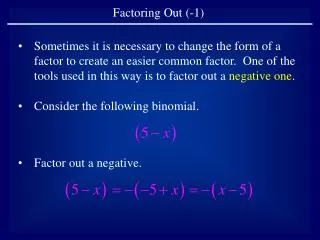
Factoring Out (-1) • Sometimes it is necessary to change the form of a factor to create an easier common factor. One of the tools used in this way is to factor out a negative one. • Consider the following binomial. • Factor out a negative.
Notice the pattern from to the equivalent form • Think of the process in the following steps for factoring a binomial that is a difference (not a sum). • Write a negative sign in front of the parenthesis. • Switch the two terms inside the parentheses, keeping the minus sign in the middle.
Example 3: Factor a negative out of the binomial.
Example 4: Factor a negative out of the binomial in the second term. This negative will be multiplied by the - 5 resulting in + 5.