CRCT Question
Explore the impact of various seismic waves, including surface waves, S-waves, and P-waves, on Earth's surface and their potential to cause damage. This educational journey covers the principles of deformation due to tectonic stress, types of faults, and folds in the Earth's crust. Learn how compressive, tensile, and shear stress contribute to geological changes and the formation of mountains and valleys. Prepare for tests on earthquakes and volcanoes while engaging in vocabulary building and discussions about Earth's dynamic processes.

CRCT Question
E N D
Presentation Transcript
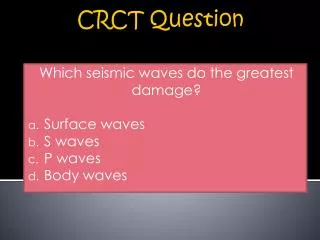
Which seismic waves do the greatest damage? Surface waves S waves P waves Body waves CRCT Question
Week at a Glance Monday: Intro to new Unit, Deformation Notes and Tier 1 Work time Tuesday: NO SCHOOL Wednesday: EOMTIER 1 DEFORMATION due Plate Tectonic Test answers, Earthquake Notes Thursday: Earthquake Extension. Tier work time Friday. TIER 2 EARTHQUAKES DUE. Tier Workday
Unit 5: Earthquakes & Volcanoes Two week unit! Week 1: Earthquakes Week 2: Volcanoes
Tiers 3 categories: Deformation, Earthquakes, and Volcanoes Your tier 3 will incorporate language arts and science! Dates to Enter • Tier 2 Earthquakes : 11/9 • Tier 1 E and V: 11/13 • Tier 3: 11/16
Keep track of when things are due!! Remember: Tier 1 completion grade Tier 2 and 3 will use a Rubric Project Due Dates
You will get Wednesday Vocabulary Sheet
Where’s My Outline? • You will make your own for a review activity in class!
http://www.youtube.com/watch?v=DppbibMhAXU Part 1: Deformation
Group Discussion Try to think of 3 words that go with Earthquakes!
All you need to know about Deformation and the Earth’s Changing Surface! Coffee Talk
Earth’s Changing surface I. Crust – the surface layer of the earth • Continental: land not under the oceans • Average of 32km, but can be as thick as 70km II. Oceanic • Ocean floor • Average of 8km thick Review: Which one is denser?
III. StresS a. The forces that pull and push on the earth’s crust b. Causes deformation – the tilting, breaking or folding of rock
i. Compression Compression – squeezes the rocks of the crust, decreasing volume, increasing density Think: Covergent
ii. Tension Tension – pull the rocks of the crust, increasing volume, decreasing density Think: Divergent
iii. Shearing Shearing – the crust being pushed in opposite directions causing the rocks to tear and twist Think: transform
Review #1. Match the set of arrows to the 3 stress • Shearing • Tension • Compression
Fractures and Faults c. Fracture – cracks in rocks d. Fault – crack along which rocks move sideways, up, or down. • Fault block mountains form from the normal faults pushing up rock • Rift valleys form when land between normal faults slide down
Folding e. Folding – a bend in the rock i. Anticline – an upward fold ii. Syncline – a downward fold iii. Appalachian mountains are made from folds
f. Factors that affect faulting or folding i. Higher temperatures will cause folding/lower temps. cause faulting ii. Greater pressure causes folding/lower pressure causes faulting Rock type iii. Brittle rock will more likely fault iv. Ductile (bendable) rock will more likely fold v. Pressure applied gradually will cause folding/fast will cause faulting
Review #2 What’s the difference between anticline and syncline folding?!
Tier 1 DeformationCOMPLETION Option 1 Words Stress Folding Faulting Anticline Syncline Temperature and folding Rock type and folding Compression Tension Shearing Fracture Due WEDNESDAY Option 1: Flashcards-Use textbook Option 2: Read textbook section on stresses of the Earth starting on page 213. Next, Complete question 1-12.