Download
1 / 9
150 likes | 274 Vues
Explore the mechanics behind electric generators, from rotating turbines to AC current generation. Learn about hydro and wind power, and the transformation of energy forms. Discover the principles of peak voltage and current. Dive into the intricacies of wind energy and the Le Nordais Wind Turbine data. Join us to demystify power generation processes!

E N D
How Does an Electric Generator Work? • Rotating turbine attached to an electrical generator, a wire coil. • Free electrons moving in a magnetic field leading to an AC current. PhET Generator - Electricity
How Are AC Currents Generated? • Electricity is generated via transforming other forms of energy.
DC and AC Currents R - + a b ~ DC AC V(t) = V0 V(t) = V0sin(2 f t) I(t) = I0 I(t) = I0sin(2 f t) Peak voltage: V0 Peak current: I0
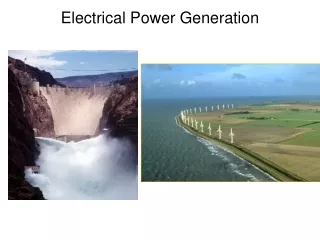
Hydro Power Gravitational potential energy is transformed into electrical energy. Power = Energy/Time P = Dm g h/Dt the power depends on the amount of the water per unit time. P = r g h (DV/Dt) The term in brackets is the flow rate, which is a volume per unit time, measured in m3/s.
Wind Power • Wind energy is in form of kinetic energy: K = ½ m v2 • in terms of a flow rate and consider power: Using the density (r = 1.28 kg/m3 for air). P = ½ r (DV/Dt) v2 • Important for the windmill is the amount of wind that moves through the area A defined by the rotor blades: DV/Dt = A Dx/Dt = A v. • P = ½ r A v3
Wind Power: Le Nordais Wind Turbine This is data from a online text. We can proof that it’s wrong! P = ½ r A v3 (available power) = 28.5 kW (at 15 km/h) = 1.12 MW (at 51 km/h)