Download
1 / 7
70 likes | 207 Vues
Delve into the fascinating world of seismograms and earthquake hunting. Discover the differences between P and S waves, the functions of seismometers, and how seismograms provide crucial data about earthquakes. Learn about the techniques used to locate the epicenter of an earthquake and the significance of time-distance graphs. This informative guide offers insights into how seismometers measure vibrations in the Earth's crust and how the amplitude of waves relates to distance. Equip yourself with knowledge about earthquake detection technology.

E N D
1. Body Waves: P and S waves • P or primary waves • fastest waves • travel through solids, liquids, or gases • compressional wave, material movement is in the same direction as wave movement • S or secondary waves • slower than P waves • travel through solids only • shear waves - move material perpendicular to wave movement
2. Seismometer • A seismometer is an instrument used to record vibrations in the Earth’s crust. • The graph that shows the vibrations is called a seismogram. • The seismometer must be able to move with the vibrations, yet part of it must remain nearly stationary. • *Most modern seismometers are computerized
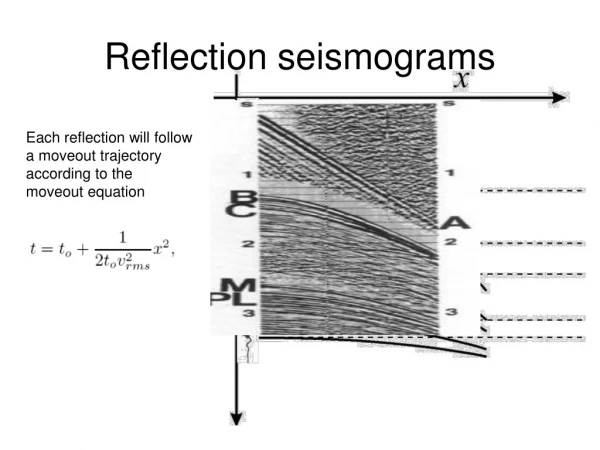
3. Seismograms • Provides information: • P wave arrival • S wave arrival • S-P interval • Amplitudes of each wave • What can be taken from this: • Distance of earthquake from seismograph • Magnitude of earthquake
4. How is an Earthquake’s Epicenter Located? • Time-distance graph showing the average travel times for P- and S-waves. • The farther away a seismograph is from the focus of an earthquake, the longer the interval between the arrivals of the P- and S- waves
5. Nomogram …Amplitude Decreases As Distance Increases… But Magnitude stays the same!! (M=5.5)
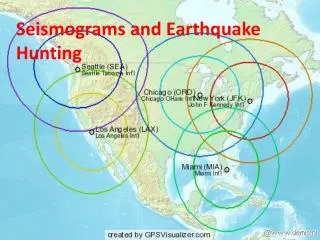
6. How is an Earthquake’s Epicenter Located? • Three seismograph stations are needed to locate the epicenter of an earthquake • A circle where the radius equals the distance to the epicenter is drawn • The intersection of the circles locates the epicenter